Perforated sheet · cut to size
Perforated sheet cut to size: dimensions, shape and ordering
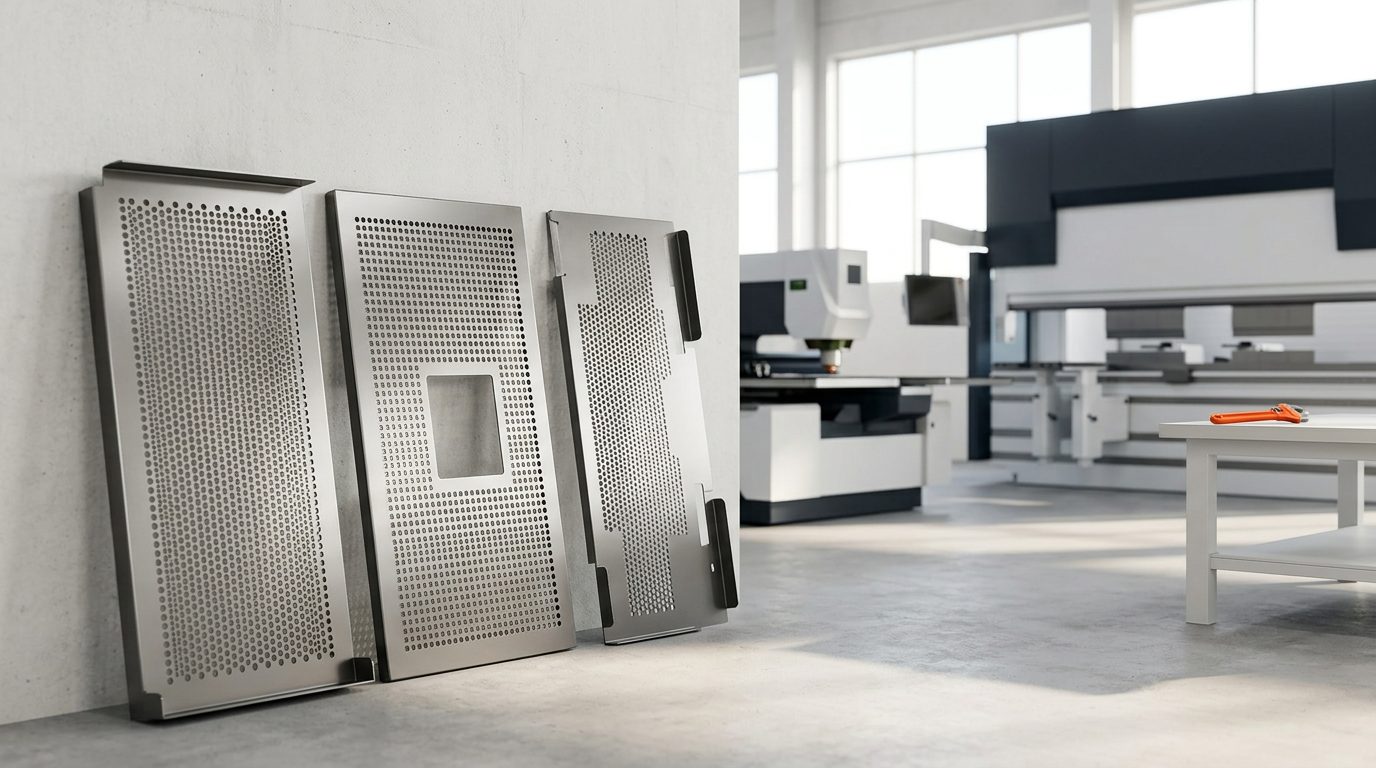
Perforated sheet cut to size means perforated sheet cut exactly to your dimensions and shape — not just a sheet chopped off, but a finished part with holes, cut-outs and, if needed, ready for bending. It is used where you need air, light or sound to pass through combined with strength and good looks: covers, grilles, ventilation panels, façade elements, filtration. Below is what to think about when ordering made to measure.
What "made to measure" means for perforated sheet
Perforated sheet is usually sold as standard sheets with a regular perforation. "Made to measure" adds what a specific part needs:
- Exact size and shape. The part outline including chamfers, radii and mounting cut-outs, not just a rectangle.
- Controlled margins. A solid border (frame) left around the perforation for strength, fixing or welding.
- Mounting features. Holes for screws, slots, embossings and areas for adjoining parts.
- Preparation for bending. A flat pattern designed so the part can be bent without the perforation clashing with the bend.
Choosing the perforation and material
Appearance and function are determined by the type of perforation — round holes (in straight or staggered rows), square, slotted — and the open area, i.e. what percentage of the area the holes make up. A higher open area means better flow but lower stiffness. The material is chosen by environment: for interiors and painted parts mild steel is enough; for humid and outdoor use, galvanised or stainless steel is suitable. We deliberately keep a narrow stock that covers ordinary engineering needs with room to spare: stainless 1.4307 (304L, 2B finish) in 1–4 mm, mild steel DC01 in 1.5–3 mm and galvanised sheet DX51D+Z275 in 1–3 mm. Stock materials are cheaper and available straight away, so we recommend making samples, prototypes and trials from them — for stainless, stock 304L is the right choice. We buy special grades only for series production, once the concept is settled and production genuinely needs their properties.
Cutting to size and shape
We make custom perforated sheet from flat sheet on a combined TRUMPF machine that both punches and fibre laser cuts in a single clamping. A regular perforation is usually punched with standard tools — for repeated holes that is faster than laser — and the outline, mounting cut-outs and irregular shapes are cut by the laser with a clean edge and accuracy in tenths of a millimetre. We process sheet up to 6 mm thick in sheet sizes up to 1250 × 2500 mm; we do not do thicker plate. The article on sheet metal cutting covers how cutting works and which methods are available. If the part is also bent, make sure the bend does not run across the perforation — a bend across a row of holes is weaker and harder to form.
How to order perforated sheet cut to size
Upload a 3D model of the part (STEP/STP) to the calculator — whether flat or intended for bending. No special tooling or minimum quantity is needed, so we will quote and make even a single part. You get the price and lead time straight away in our instant quote calculator — the cut length, weight and price are calculated automatically from the uploaded file.
Frequently asked questions
Can I have perforation on just part of the panel?
Yes. The perforation can be limited to a chosen area, with a solid margin left around it for strength, fixing or welding — one of the main advantages of making to measure.
Can perforated sheet be bent?
It can, but the bend should not run straight across a row of holes — the sheet is weakened there and harder to form. Ideally, it is bent along a solid strip of material.
Which material should I choose for outdoor use?
For humid and outdoor environments, galvanised DX51D+Z275 or stainless 1.4307 (304L) is suitable. For interiors and painted parts, mild steel DC01 is enough.
Up to what thickness do you make perforated sheet?
Up to 6 mm, from sheet up to 1250 × 2500 mm. We punch or laser cut the perforation on a TRUMPF machine; we do not do thicker plate.
What file should I send?
The instant quote calculator accepts a 3D model (STEP/STP) — for flat parts as well as parts to be bent; we derive the flat pattern and the flat length from the model. Only have a DXF or a PDF drawing with the outline and perforation for a flat part? Send it via an enquiry.
Know which perforated part you need? Upload the file and get the price and lead time instantly.