Sheet metal cutting
Sheet metal cutting: laser or shearing — which to choose and what it costs
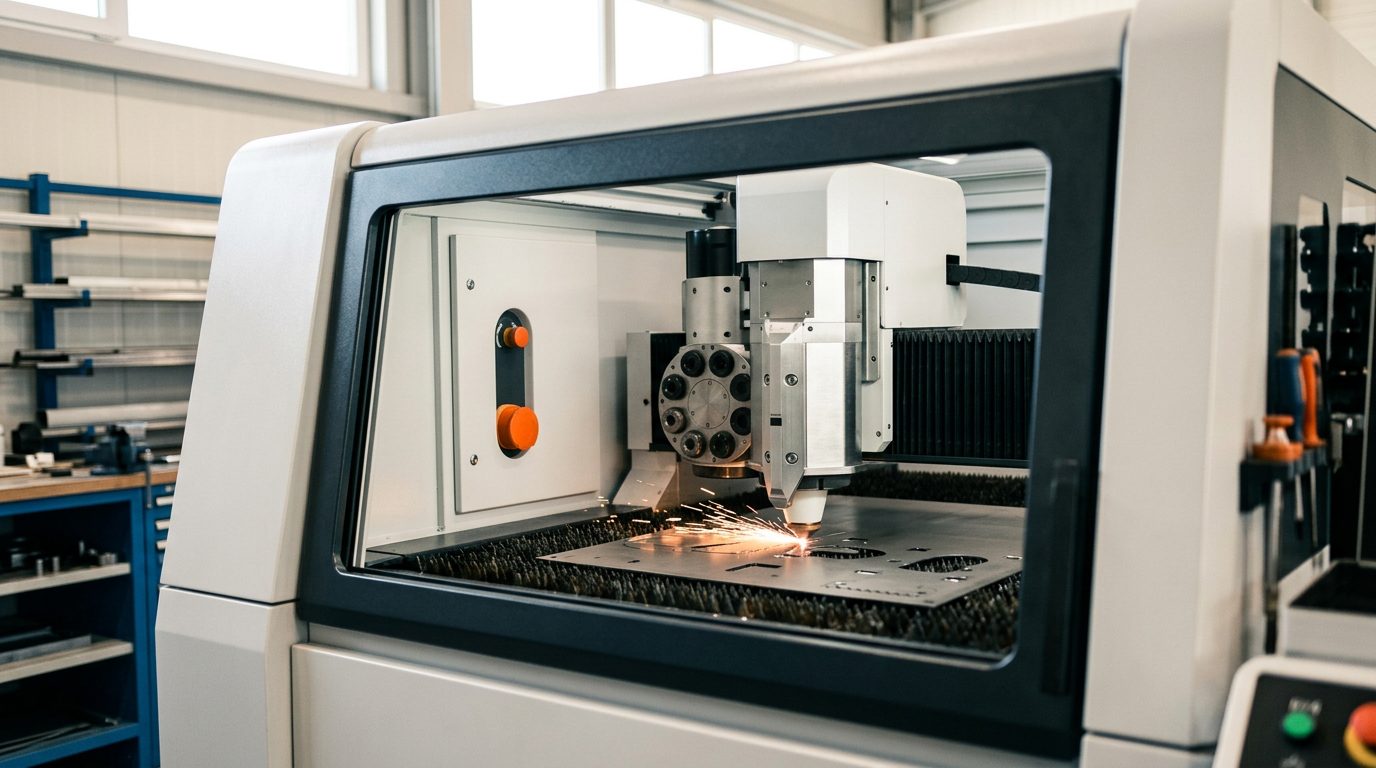
Sheet metal cutting is the first step of almost every sheet metal job — a sheet or coil becomes a flat blank (laser-cut part), which is then bent, welded or machined. The cutting method determines accuracy, edge quality and price. This overview will help you find your way around the methods and estimate what your parts really need.
Sheet metal cutting methods and when to use each
In practice you will come across four main ways of dividing sheet metal:
- Laser (fibre). Today's standard for precision parts. Narrow kerf, a clean burr-free edge, fine detail and small holes. Excellent for steel, stainless and aluminium. Powerful fibre lasers can now handle thick plate too — but the actual range is always set by the power and bed size of the specific machine.
- Plasma. Fast and cheap on structural steel, but with a rougher edge and a larger heat-affected zone. Suited to work where a wider kerf and subsequent machining do not matter.
- Waterjet. A cold cut with no heat input — suitable where no oxide scale or change in the material structure is allowed, and for materials that cannot be laser cut. Slower and more expensive.
- Shearing (guillotine shears, saw). The cheapest option for straight cuts and simple blanks, but with no contoured cut-outs or holes.
For custom parts our starting point is the TRUMPF TruMatic — a machine that combines punching with a fibre laser and produces an accurate blank with holes, cut-outs and formed features in a single pass. The part goes straight to bending with no intermediate operations.
What we cut in-house — and what we don't
Our modern equipment deliberately covers the thin and medium-gauge segment up to 6 mm that our group of companies needs. The machine's working format is 1250 × 2500 mm; a larger sheet (for example 1500 × 3000 mm) does not fit and has to be sheared to size first. We do not offer plasma, waterjet or cutting of thick plate — if your part needs one of these technologies or a thickness above 6 mm, we will tell you straight that we cannot make it.
Edge quality and tolerances
At common thicknesses a laser-cut edge is smooth, square and practically burr-free, so it needs no chamfering or grinding before further processing. The dimensional tolerance of a laser-cut part is in the tenths of a millimetre, which is enough even for parts that are subsequently welded or fitted. Plasma and waterjet usually have a wider kerf and an edge with a slight bevel — allow for this if precise fitting follows.
An accurate blank is also a precondition for an accurate bend. Sheet metal bending cannot fix an inaccurate edge, which is why we treat cutting and bending as one digitally connected chain.
What makes up the cost of cutting
The price of a laser-cut part is not just a "price per metre of cut". It is made up roughly of these components:
- Material — the weight of the blank and the current price of sheet in that grade and thickness.
- Cut length — the part perimeter plus all holes and cut-outs; a longer path means more machine time.
- Number of features — every hole and cut-out means a lead-in and a pierce, and these add up.
- Thickness and material — thicker and harder sheet is cut more slowly.
- Quantity — on a larger batch the price per part falls (better sheet utilisation, less set-up).
Smart design can also lower the price. It helps to stick to the thicknesses and grades we hold in stock (lower material price and immediate availability), not to draw unnecessarily dense cut-outs and small holes close together, and on larger batches to let the parts be packed efficiently on the sheet (nesting) to minimise scrap. Corner radii instead of sharp internal corners also speed up the cut and extend the life of the part.
Because there are so many variables, a manual estimate tends to be inaccurate. In our instant quote calculator, the cut length, weight and price are calculated automatically from the uploaded file, and you see the result within seconds.
Frequently asked questions
What file should I send for sheet metal cutting?
For flat parts, a DXF of the flat pattern is ideal. For parts that will be bent afterwards, send a 3D model (STEP/STP) instead — we derive the flat pattern from it, including the correct flat length.
Up to what thickness do you laser cut?
We process sheet up to 6 mm by laser and punching, in sheet sizes up to 1250 × 2500 mm. Thin and medium-gauge sheet is the segment our equipment is deliberately built for. We do not do thicker plate, plasma or waterjet.
Do the edges need further finishing after cutting?
With laser, usually not — the edge is clean and burr-free. We chamfer or deburr only where the function of the part or safety requires it.
Is it worth ordering just a few parts?
Yes. No tooling or minimum quantity is needed, so we will quote and make even a single part. On a larger batch the price per part then falls.
Know what you need cut? Upload the file and get the price and lead time instantly.