Laser · profiled sheet
Cutting box profile (trapezoidal) sheet to size: what to watch out for
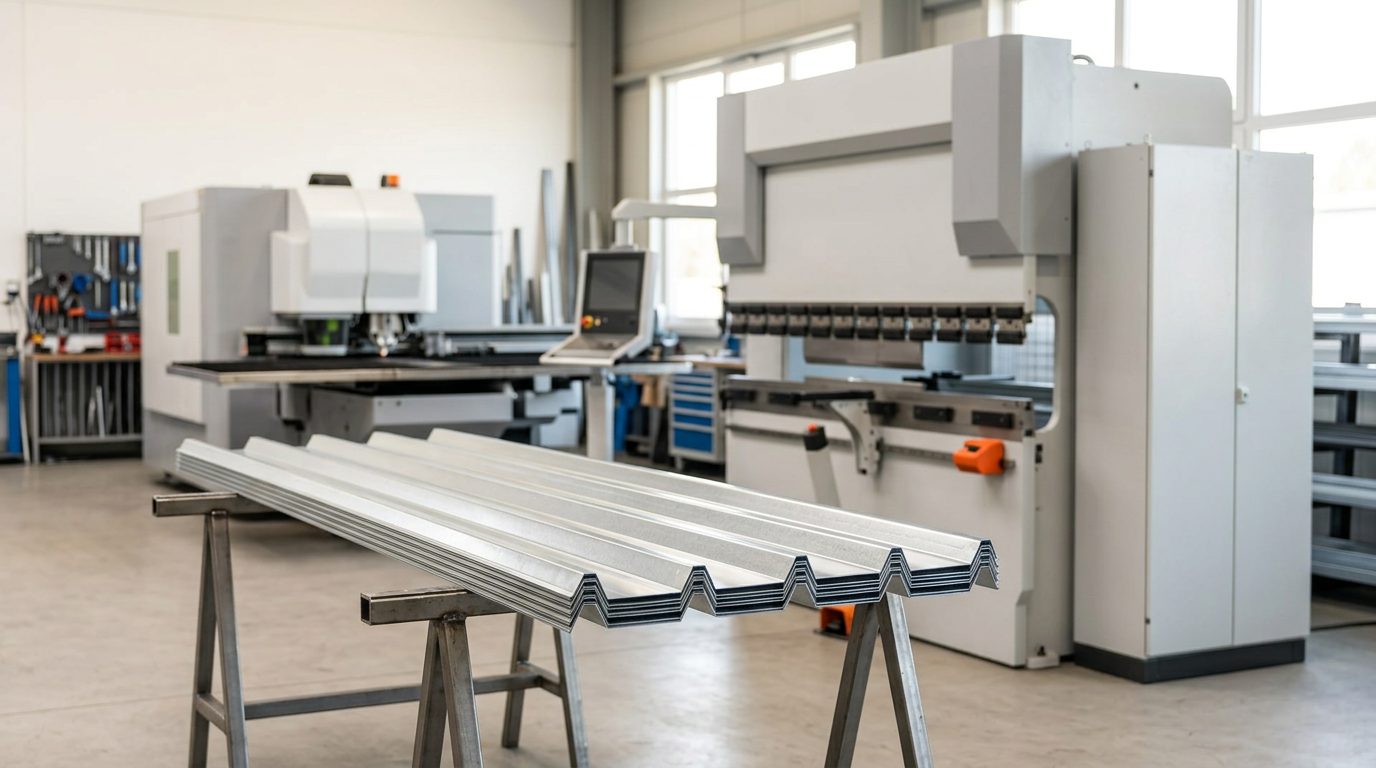
Cutting box profile (trapezoidal) sheet has its own specifics that make it different from cutting a flat sheet. Box profile (profiled) sheet has a pressed-in wave — higher and lower ribs alternate — and that geometry affects how, and with what, it can be cut to size. This article sums up what to consider before having profiled sheet cut to size, and says openly what we will and will not do.
How box profile sheet differs
Box profile sheet is thin galvanised (often pre-painted) sheet pressed into a profile that gives it stiffness at low weight. It is used for roofs, façades, soffits and structural cladding. But it is the profile that complicates cutting: the sheet does not lie in one plane, so the cut runs across both crowns and troughs, and the part cannot be clamped like a flat sheet. The second issue is the coating — both zinc and paint are sensitive to heat and mechanical damage, and we want to avoid that when cutting.
Which cutting methods make sense
Finished box profile sheet is in practice most often cut mechanically — with a nibbler (punch-type shears) or a circular saw with a suitable metal-cutting blade. These methods put no heat into the material, so they do not burn the zinc or paint and produce no scale. An angle grinder with a cutting disc is not recommended — its high temperature burns off the zinc layer around the cut and creates a starting point for corrosion.
What we do — and what we don't
We work with a combined TRUMPF machine (a fibre laser with a punching head) and a TRUMPF TruBend press brake. Both are technologies for flat sheet: the sheet lies flat on the work table and the machine treats it as a plane. Finished box profile sheet cannot be reliably cut on them — the wave does not lie in one plane, the laser could not hold its focus and the punching head would deform the profile. We therefore do not offer shortening or modifying finished box profile sheets; that is done mechanically on site or directly by the profile manufacturer, who supplies the sheets in the required length.
What we can make for roofs, façades and cladding are parts from flat sheet: flashings, trims, verge and eaves trims, corner and gable pieces, fixing and mounting plates. We laser cut or punch them and bend them on the press brake, from flat sheet up to 6 mm thick and in sheet sizes up to 1250 × 2500 mm. We stock galvanised sheet DX51D+Z275 in 1 and 2 mm (1000 × 2000 mm) and in 2 and 3 mm (1250 × 2500 mm), so common roofing and mounting parts made from it are cheaper and available straight away. The article on the laser cutting process describes how laser cutting works. A comparison of cutting methods is in our overview of sheet metal cutting.
Edge quality and protecting the surface
With profiled sheet, the key is to protect the cut edge. Flying hot swarf can damage the paint on surrounding areas, so the sheet is covered while cutting and the swarf is removed immediately so that it does not rust and leave rust spots on the surface. The cut edge should be treated. On galvanised sheet, small cut edges are protected cathodically by the surrounding zinc, which corrodes preferentially instead of the steel; larger cut areas are not covered by this protection, so they are treated with zinc paint. On painted parts a touch-up paint is recommended.
How to prepare an order for accessory parts
To quote flashings and other sheet metal parts, we need to know the material and thickness, the dimensions or flat pattern of the part, the bend angles and the number of parts. For non-standard shapes, a simple sketch or a dimensioned drawing (DXF, PDF) helps — send it via the enquiry form. If you have a 3D model (STEP/STP), the instant quote calculator works out the price directly. The more precise the brief, the more precise the price and lead time.
Frequently asked questions
Can box profile sheet be laser cut?
Not reliably as a finished profile on a standard flat-bed laser — the wave does not lie in one plane. That is why it is cut mechanically (nibbler, saw), so as not to damage the zinc and paint. A laser makes sense for flat sheet.
Will you cut box profile sheets to size for me?
No, we do not offer shortening of finished box profile sheets — our machines work with flat sheet. The profile manufacturer supplies sheets in the required length, or they are shortened mechanically on site. We make the accessory parts from flat sheet: flashings, trims, cladding pieces and mounting plates.
Why shouldn't box profile sheet be cut with an angle grinder?
The grinding disc generates a high temperature, and the flying sparks burn the zinc layer and the paint around the cut. That creates a starting point for corrosion, and the sheet begins to rust at the cut.
How should the cut edge be treated after cutting?
On galvanised sheet, the surrounding zinc protects a thin cut edge to a certain extent (cathodic protection); for larger cut areas we recommend zinc paint. On painted sheet we recommend touch-up paint. In both cases, remove all hot swarf from the surface.
What should I supply to get accessory parts quoted?
Material and thickness, dimensions or flat pattern, bend angles, number of parts and, where relevant, a sketch or DXF. With that we can quote and make the part.
Need flashings or other parts from flat sheet? Upload a 3D model (STEP/STP) and get the price and lead time instantly.