Laser · process
The laser cutting process — from DXF to finished sheet metal part
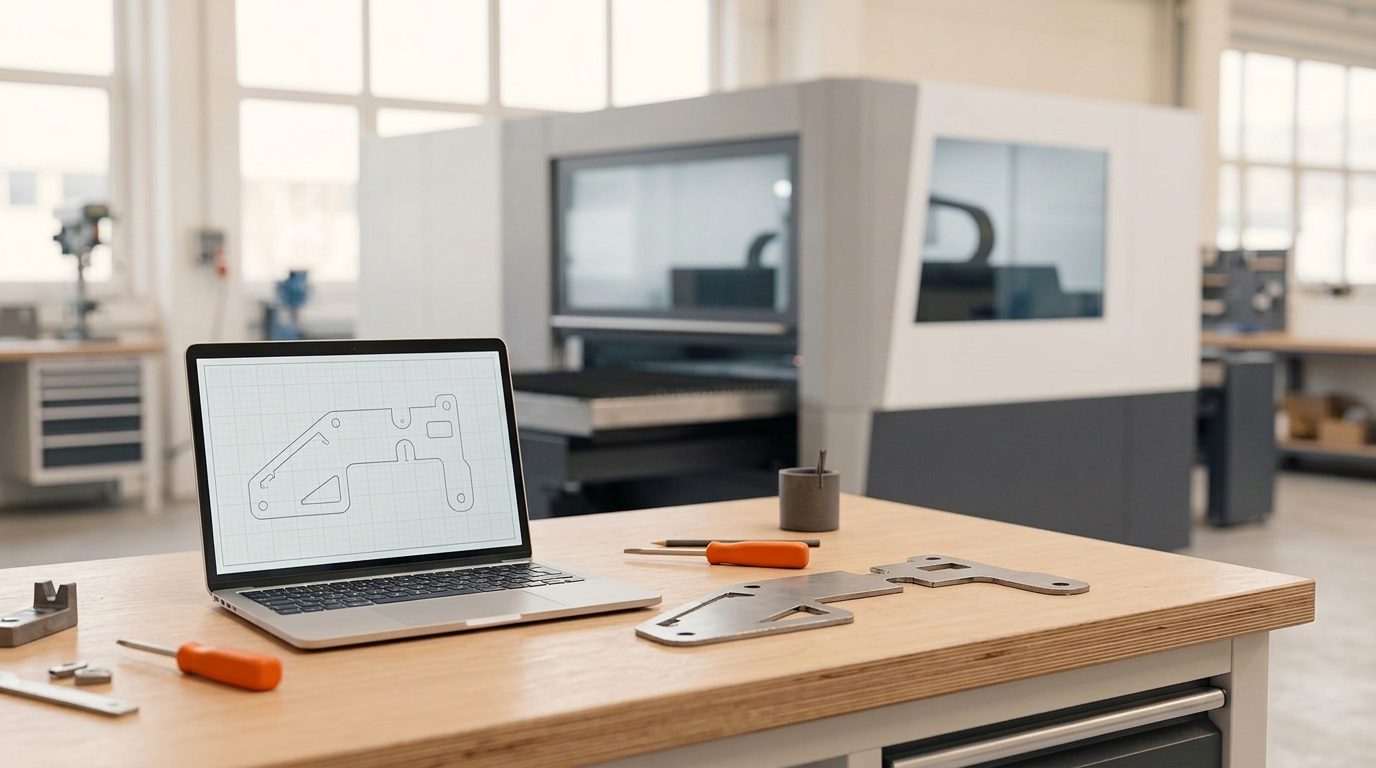
Laser cutting of sheet metal is today one of the most accurate and fastest ways of turning a sheet into a finished flat part. As a buyer, though, it helps to know what actually happens between sending the file and collecting the part — understanding the process helps you prepare better data and avoid needless mistakes. Let's go through the whole route from DXF to finished part.
Data preparation: DXF or 3D model
Everything starts with the file. For purely flat parts a DXF of the flat pattern is ideal — it contains the exact outline, holes and cut-outs at a true 1:1 scale. For parts that are bent after cutting, it is better to send a 3D model in STEP (STP) format: the flat pattern is derived from it automatically, including the correct flat length, so the blank comes out to size after bending. The data are checked before cutting — whether the contours are closed, whether there are duplicate lines, and whether holes and cut-outs are smaller than the given material thickness can reliably cut.
Nesting: arranging parts on the sheet
The individual parts are laid out on the sheet in software so as to leave the least possible scrap — this is called nesting. On a larger batch, parts are fitted into one another and share cut edges, which reduces material consumption and machine time, and therefore the price per part. That is why it pays to send parts for a volume order together, not one at a time. Our machine works with a 1250 × 2500 mm sheet format; a larger sheet (for example 1500 × 3000 mm) does not fit and would have to be sheared to size first.
The cut itself on a fibre laser
A fibre laser focuses the beam to a spot a few tenths of a millimetre across and melts through the sheet; a jet of assist gas (nitrogen or oxygen) blows the molten metal out of the kerf. The kerf is so narrow that it fits into complex details and small holes. The edge comes out smooth, square and practically burr-free, so the part usually needs no further finishing. What thickness a given laser can handle is determined mainly by its power. Our modern equipment deliberately covers the thin and medium-gauge segment up to 6 mm that our group of companies needs — we do not do thicker plate.
In jobbing production the laser is often integrated into a combined machine (for example the TRUMPF TruMatic), which combines punching with a fibre laser — holes, extruded holes for threads and formed features are made in one pass, and the part goes straight to bending with no intermediate operations. We do not offer plasma or waterjet; you will find them compared with laser in our overview of sheet metal cutting.
Tolerances and edge quality
The dimensional tolerance of a laser-cut part in thin and medium-gauge sheet is in the tenths of a millimetre, which is enough even for parts that are later welded or fitted. Accuracy is affected by the thickness tolerance of the sheet, heat input into the material and the density of features in a small area. An accurate blank is also a precondition for an accurate bend — subsequent bending cannot fix an inaccurate edge.
Frequently asked questions
Which file format is best for laser cutting?
For flat parts, a DXF of the flat pattern at 1:1 scale. For parts that will be bent afterwards, a STEP (STP) 3D model is better — we derive the flat pattern and flat length from it automatically.
How small can holes and details be?
As a rule of thumb, the smallest reliable hole has a diameter roughly equal to the sheet thickness; on thin sheet you can go lower. Holes that are too small for the material thickness have a rougher edge and lengthen the cut.
Up to what thickness do you cut?
Up to 6 mm, in sheet sizes up to 1250 × 2500 mm. All stock materials (stainless 1.4307, mild steel DC01, galvanised DX51D+Z275) are within this range. We do not do thicker plate, plasma or waterjet.
Do I need to deburr the edges after cutting?
With laser, usually not — the edge is clean and burr-free. We chamfer or deburr only where the function of the part or operator safety requires it.
How long does it take to get a price?
Instantly. The cut length, weight and price are calculated from the uploaded file within seconds — the article on laser cutting cost goes into this in detail.
Have a 3D model (STEP/STP) ready? Upload it and see the price and lead time immediately, with no waiting for a sales quote.