Laser-cut parts · price
Laser-cut parts price: material, cut length and quantity
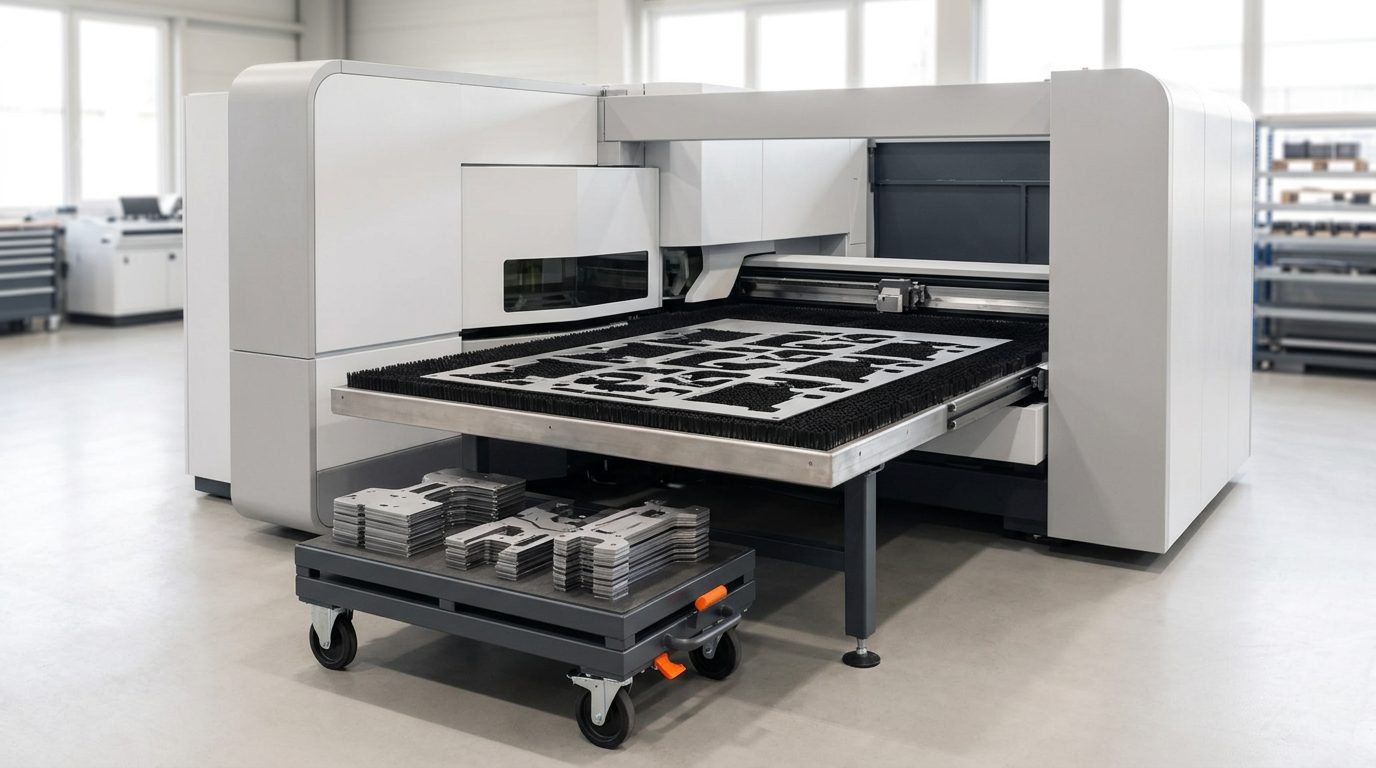
The price of a laser-cut sheet metal part is not just a "price per metre of cut". It includes the price of the material, the length of the cutting path, the number of holes and cut-outs, the thickness and the quantity ordered. Once you know how these components add up, it is easier to estimate the price and, above all, to design your part so it comes out cheaper. Here is an overview of what makes up the price of a laser-cut part.
What makes up the price of a laser-cut part
- Material and weight. The price of sheet in that grade and thickness × the weight of the blank. The most significant component on larger and thicker parts.
- Cut length. The part perimeter plus all holes and cut-outs. A longer path = more machine time.
- Number of features. Every hole and cut-out means a lead-in and a pierce, which add up in time.
- Thickness and material. Thicker and harder sheet is cut more slowly.
- Quantity. On a larger batch the price per part falls — better sheet utilisation (nesting) and less set-up.
Material: a stock grade is cheaper
The easiest way to save on material is to choose a commonly stocked grade and thickness. From our range, these materials, for example, are in stock:
| Material | In stock | Indicative price * |
|---|---|---|
| Mild steel DC01 | 1.5 / 2 / 3 mm (1000 × 2000) | approx. CZK 22.65–22.95/kg |
| Galvanised DX51D+Z275 | 1 / 2 mm (1000 × 2000), 2 / 3 mm (1250 × 2500) | approx. CZK 25–26/kg |
| Stainless 1.4307 (304L) | 1 / 2 / 3 / 4 mm (1000 × 2000) | approx. CZK 71/kg |
* Indicative material prices excluding VAT; they change with the market. For an idea of the price ratio between grades only. We keep a narrow stock on purpose: it covers ordinary engineering needs with room to spare, is bought in larger quantities, and is therefore cheaper and available straight away.
We recommend making concepts, samples, prototypes and tests from exactly these stock materials. For stainless samples and trials, stock 304L is the right choice. We buy special grades, such as stainless 1.4404 (316L), only for series production — once the product concept is settled and production genuinely needs their technical properties. Expect a longer lead time and a higher material price then.
How to lower the price through design
Besides the choice of material, smart part design helps too:
- Stick to standard thicknesses and common grades for availability and material price.
- Don't draw unnecessarily dense cut-outs and lots of small holes close together.
- On larger batches, let the parts be packed efficiently on the sheet to minimise scrap.
- Use corner radii instead of sharp internal corners — they speed up the cut and extend the life of the part.
The cutting method matters too. We produce on a combined TRUMPF machine that laser cuts and punches in a single clamping — repeated holes and perforations are often faster and cheaper to punch, while the laser cuts the outline and fine details. We process sheet up to 6 mm thick in sheet sizes up to 1250 × 2500 mm; we do not offer thicker plate, plasma or waterjet. More in the article on laser-cut metal parts. Structural steel grades are covered in the article on laser-cut steel parts.
How to find the price of a laser-cut part instantly
Because the price is made up of several variables at once, a manual estimate tends to be inaccurate. In our instant quote calculator the cut length, weight and price are calculated automatically from the uploaded file and you see the result within seconds — lead time included.
Frequently asked questions
Why does the same part cost more in stainless than in steel?
Stainless has a much higher price per kilogram than mild steel and cuts more slowly. Both components — material and machine time — therefore push the price up.
Do you charge for every hole separately?
Not directly, but every hole and cut-out lengthens the cut and adds a lead-in and a pierce. So more features raise the price step by step.
Is it worth ordering just a few parts?
Yes. No tooling or minimum quantity is needed, so we will quote and make even a single part. On a larger batch the price per part then falls.
How can I save the most on material?
By choosing a stock grade and thickness. Material that we hold in stock and buy in larger quantities is cheaper and available straight away. Make samples and prototypes in particular from stock material; special grades are worth ordering only for series production.
Up to what thickness do you make laser-cut parts?
Up to 6 mm, from sheet up to 1250 × 2500 mm. We do not do thicker plate — our equipment is deliberately built for thin and medium-gauge sheet.
Know what you need cut? Upload the file and get the price and lead time instantly.