Laser-cut parts · steel
Laser-cut steel parts: steel grades, thicknesses and uses
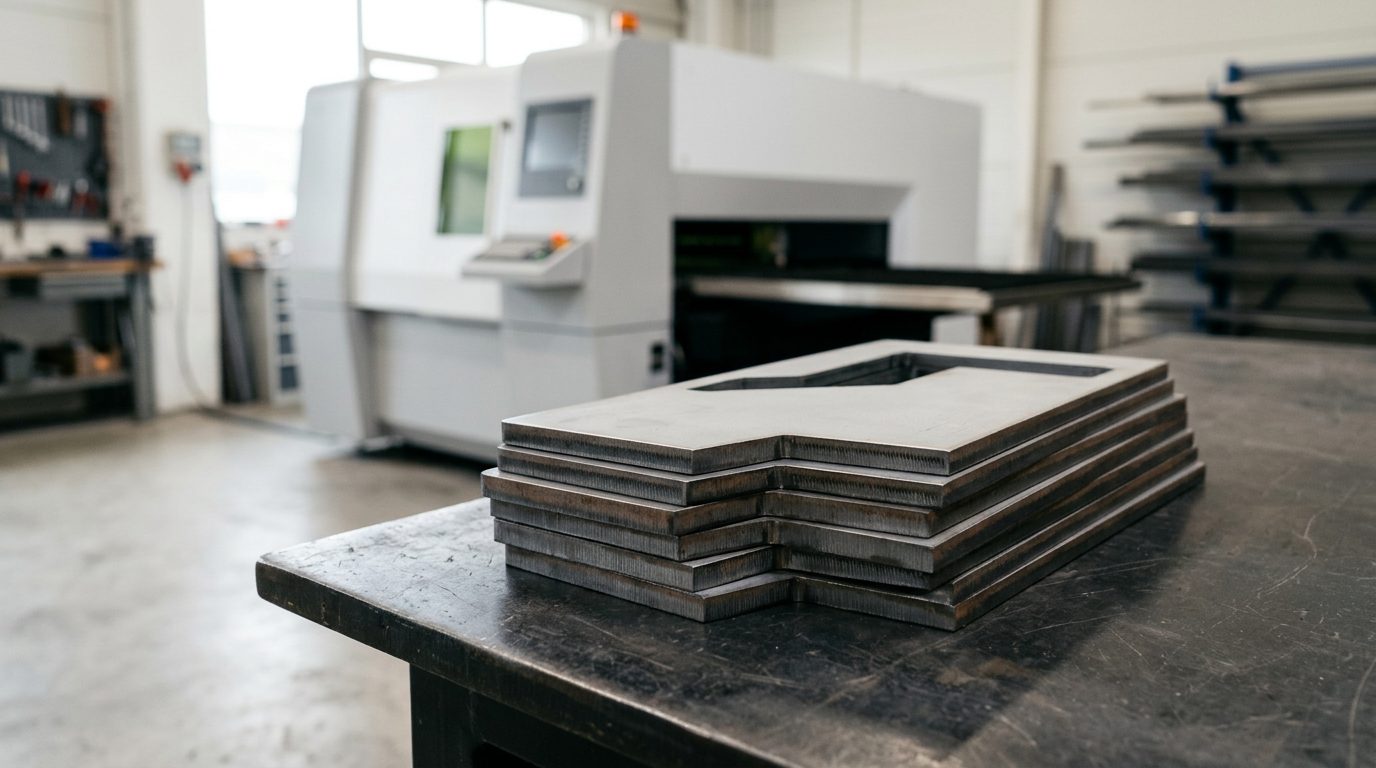
Laser-cut steel parts are flat parts cut from steel sheet — the basic semi-finished product for the vast majority of structural and mechanical engineering work. Bent, a laser-cut blank becomes a cover or a frame; welded, a load-bearing structure; machined, a precision component. This overview sums up which steel grades the parts are cut from, which thicknesses to choose and where they are used most often.
Which steel grades are used for laser-cut parts
For ordinary steel parts, these groups are the most common choice:
- Low-carbon cold-rolled steel, e.g. DC01. Intended for cold forming: ductile, bends and welds well, smooth surface — ideal for covers, brackets and parts that are formed further after cutting. We stock DC01 in 1.5, 2 and 3 mm (1000 × 2000 mm sheet size).
- Structural steel S235 / S355. Stronger, for load-bearing frames and stressed parts. Chosen where a higher yield strength is needed than cold-forming sheet provides. We do not stock it — we buy it for series production when the part really needs it.
- Galvanised steel, e.g. DX51D+Z275. Steel with a protective zinc layer for parts in humid and outdoor environments without further painting. We stock it in 1 and 2 mm (1000 × 2000 mm) and in 2 and 3 mm (1250 × 2500 mm).
We keep a narrow stock on purpose: it covers ordinary engineering needs with room to spare, and because we buy in larger quantities it is cheaper and available straight away. DC01 typically works out a few Czech crowns (CZK) per kilogram cheaper than unusual grades ordered separately — and those come with a longer lead time and a higher price.
We therefore recommend making concepts, samples, prototypes and tests from stock materials (DC01, galvanised DX51D+Z275, or stainless 1.4307 / 304L in 1–4 mm). We buy special grades only for series production, once the product concept is settled and production genuinely needs their technical properties.
Thicknesses and when each makes sense
Choosing a thickness is a trade-off between stiffness, weight and price. We process sheet up to 6 mm, in sheet sizes up to 1250 × 2500 mm. As a guide:
| Thickness | Typical use |
|---|---|
| 1.0–1.5 mm | Covers, cladding parts, brackets, electrical enclosure parts |
| 2.0 mm | All-round thickness for bent parts and moderately loaded brackets |
| 3.0–6.0 mm | Load-bearing frames, mounting plates, welded structures |
The thicker the sheet, the slower the cut and the higher the forming force when bending, so an over-specified thickness adds cost for nothing. Conversely, a part that is too thin will deflect under load — stiffness often comes more from a well-placed bend or a stiffener than from a greater thickness. We do not do thicker plate: our TRUMPF machines (a combined laser with a punching head and a TruBend press brake) deliberately cover the thin and medium-gauge segment that our group of companies needs. We do not offer plasma, waterjet or thick plate cutting.
Where laser-cut steel parts are used
Laser-cut steel parts are the basis of mechanical engineering, electrical enclosures, agricultural and transport machinery, furniture frames and signage. The typical route is: laser-cut blank → bend → weld → finish. That is exactly why it pays to deal with the blank together with the follow-on operations rather than leave edge accuracy to chance.
How to order custom laser-cut steel parts
For flat parts a DXF of the flat pattern is enough; for parts to be bent a 3D model (STEP/STP) is better. Laser cutting gives a clean, burr-free edge and a dimensional tolerance in the tenths of a millimetre — details in the article on laser-cut metal parts. You can find the price and lead time for your steel parts straight away in our instant quote calculator.
Frequently asked questions
Which steel is cheapest for ordinary laser-cut parts?
Commonly stocked cold-rolled steel such as DC01 works out cheapest, because it is bought in larger quantities and is available straight away. Unusual grades are ordered separately, so they cost more and take longer.
Can laser-cut steel parts be bent straight away?
Yes, that is the most common scenario. Cold-forming steels such as DC01 bend very well; you just need to respect the minimum radii and the distance of holes from the bend.
When should I choose galvanised steel instead of mild steel?
If the part will be in a humid environment or outdoors and you do not want to paint it, galvanised DX51D+Z275 gives basic corrosion protection straight from the material.
Up to what thickness do you make steel parts?
Up to 6 mm, from sheet up to 1250 × 2500 mm. We do not do thicker plate — our equipment is deliberately built for thin and medium-gauge sheet.
Can you do a single part?
Yes. Laser cutting needs no tooling and no minimum quantity, so we will quote and make even a single steel part.
Know which steel parts you need? Upload the file and get the price and lead time instantly.