Laser-cut parts · laser
Laser-cut metal parts: precision, edge quality and when to choose laser
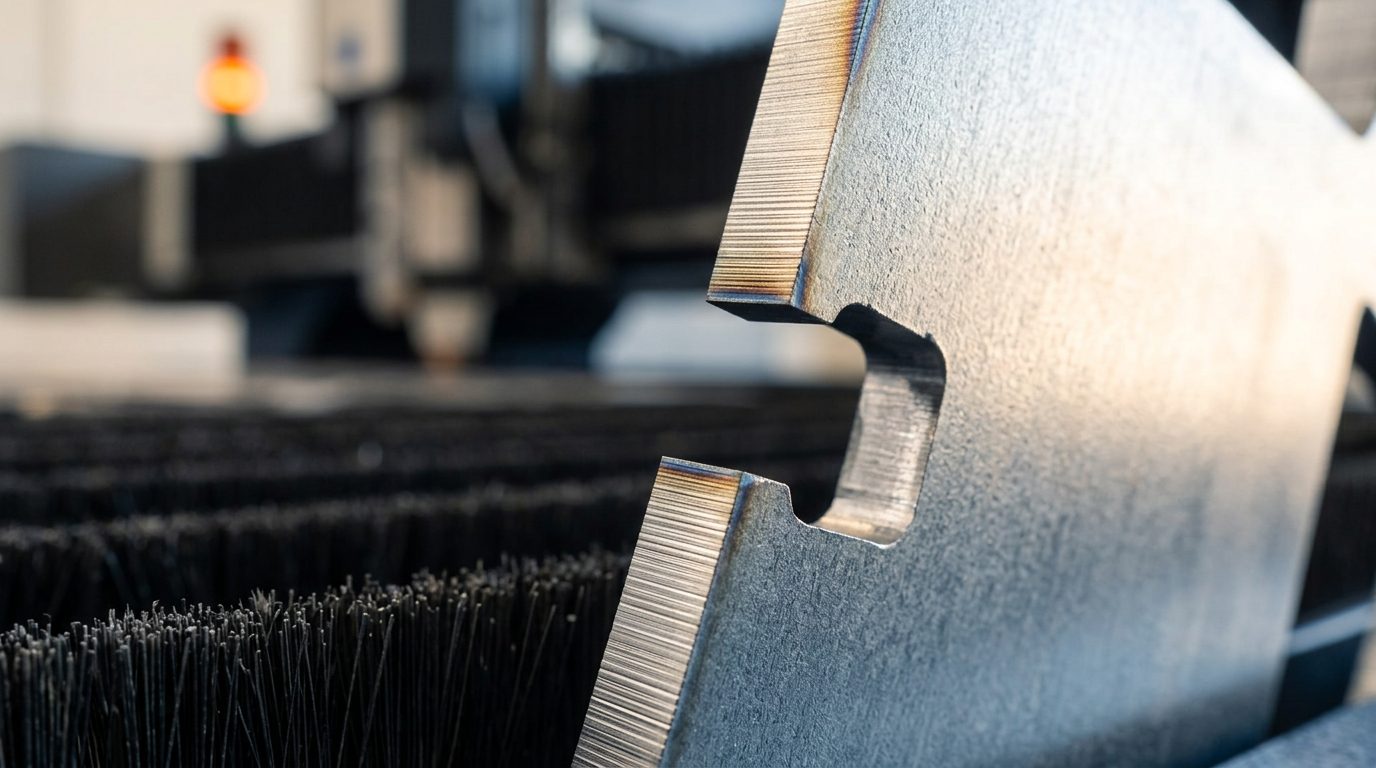
Laser-cut metal parts are flat parts cut from sheet with a fibre laser — today's standard for precise custom components. Compared with other cutting methods, a laser offers a narrow kerf, a smooth edge and very good dimensional accuracy, so the part can often go straight to bending or welding without further finishing. Below we sum up what characterises laser-cut parts, when a laser pays off and exactly what you can have made in our shop.
What characterises laser-cut parts
- A clean, burr-free edge. On thin and medium-gauge sheet the edge is smooth and practically square, so it needs no chamfering or grinding before the next step.
- A narrow kerf. The fine beam allows delicate details, small holes and tiny cut-outs that coarser methods cannot manage.
- Tolerances in tenths of a millimetre. The dimensional accuracy of a laser-cut part is in the tenths of a millimetre — enough for parts that are later fitted or welded.
- Repeatability. The cut comes from a digital file, so the first and the hundredth part are identical, with no trial-and-error scrap.
Laser vs. plasma — when to use which
The most common choice for cutting sheet metal is laser or plasma. In general they differ as follows:
| Criterion | Laser (fibre) | Plasma |
|---|---|---|
| Edge quality | Smooth, burr-free | Rougher, slight bevel |
| Accuracy | Tenths of a mm | Lower |
| Heat-affected zone | Small | Larger |
| Details and small holes | Yes | Limited |
| In our shop | Yes — sheet up to 6 mm | Not offered |
A laser is the first choice for precise parts from thin and medium-gauge sheet. Plasma has its place where a wider kerf and subsequent machining do not matter — but we do not offer it. Our production is built on a combined TRUMPF machine (a fibre laser and a punching head in one) and a TRUMPF TruBend press brake. It deliberately covers the thin and medium-gauge segment up to 6 mm that our group of companies needs, in sheet sizes up to 1250 × 2500 mm. Thicker plate, plasma and waterjet are not available from us — and we say so up front. A broader comparison of cutting methods is in the article on sheet metal cutting.
Materials for laser cutting — and why to start with stock ones
Structural steel, cold-rolled forming steel (DC01), galvanised steel and stainless all laser cut well. We deliberately keep a narrow stock: it covers ordinary engineering needs with room to spare and, because we buy in larger quantities, it is cheaper and available straight away. We stock stainless 1.4307 (304L, 2B finish) in 1, 2, 3 and 4 mm, mild steel DC01 in 1.5, 2 and 3 mm, and galvanised sheet DX51D+Z275 in 1 and 2 mm (1000 × 2000 mm) and in 2 and 3 mm (1250 × 2500 mm).
We therefore recommend making concepts, samples, prototypes and tests from exactly these stock materials — it works out cheaper and there is no waiting for material. For stainless samples and trials, stock 304L is the right choice. We buy special grades, for example stainless 1.4404 (316L), only for series production, once the product concept is finished and production really needs their technical properties. More on structural steel grades in the article on laser-cut steel parts.
How to order custom laser-cut parts
Upload a 3D model of the part (STEP/STP) to the calculator — whether flat or intended for bending. Laser cutting needs no tooling and no minimum quantity, so we will quote and make even a single part. You get the price and lead time straight away in our instant quote calculator — the cut length, weight and price are calculated automatically from the uploaded file.
Frequently asked questions
Up to what thickness do you laser cut?
In our shop up to 6 mm, in sheet sizes up to 1250 × 2500 mm (a larger 1500 × 3000 mm sheet has to be sheared to size first). Our equipment deliberately covers thin and medium-gauge sheet. We do not do thicker plate and will not pretend otherwise.
Do the edges need finishing after laser cutting?
Usually not — the edge is clean and burr-free. We chamfer or deburr only where the function of the part or safety requires it.
What is the difference between a laser-cut and a plasma-cut part?
A laser gives a smooth edge and accuracy in tenths of a millimetre, and handles fine details. Plasma leaves a rougher edge with a slight bevel and a wider kerf. We do not offer plasma cutting — we work exclusively with laser and punching.
What material should I use for a sample or prototype?
A stock one: stainless 304L, DC01 steel or galvanised DX51D+Z275. It is cheaper and available straight away. Special grades such as 316L are worth ordering only for series production, once the concept is settled.
What file should I send?
The instant quote calculator accepts a 3D model (STEP/STP), for flat parts as well as parts to be bent; we derive the flat pattern and the correct flat length from the model. Only have a DXF or a PDF drawing for a flat part? Send it via an enquiry.
Need precise sheet metal parts? Upload the file and get the price and lead time instantly.