Bending · calculation
Bend allowance and flat length: the K-factor with worked examples
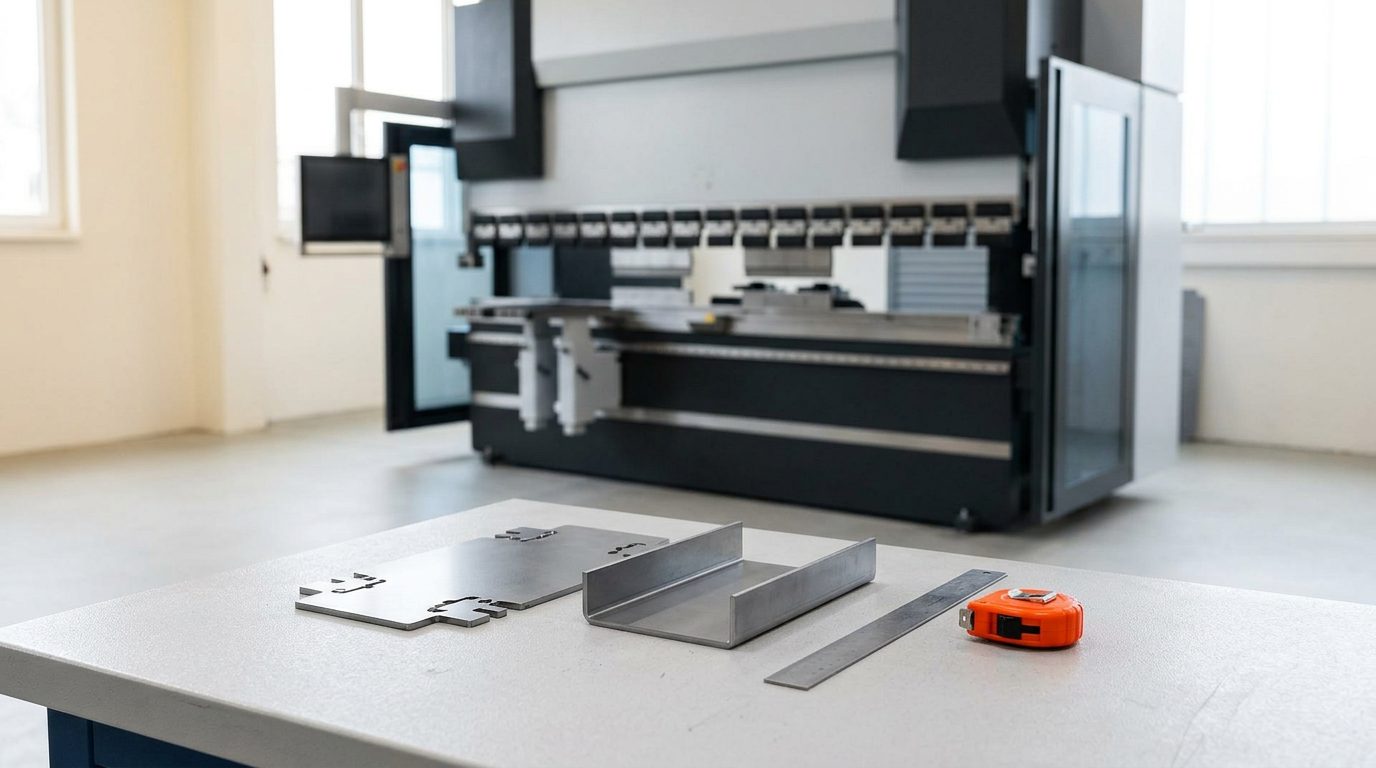
Getting the bend allowance right when bending sheet metal decides whether the part comes out to size after bending. The sheet deforms at the bend, so the flat blank has to be slightly different from the sum of the outside dimensions of the finished part. In this article we explain the neutral axis and the K-factor, and calculate the flat length step by step using an example.
Why adding up the flanges is not enough
During bending, the material stretches on the outside and is compressed on the inside. Somewhere in between lies the neutral axis, whose length does not change — and it is the neutral axis that determines how long the flat blank must be. If you added up the outside dimensions of the flanges, the part would come out longer than intended after bending. The difference is expressed through two terms: bend allowance and bend deduction.
The K-factor and the neutral axis
The K-factor gives the position of the neutral axis within the sheet thickness — as the ratio of its distance from the inside of the bend to the total thickness. It takes values of roughly 0.3 to 0.5 and depends on the material, thickness and bend radius. For ordinary steel, a value of around 0.38–0.44 is often used as a starting point; the exact value is only confirmed by a test bend, because every material and tool behaves slightly differently.
The bend allowance (BA) — the arc length of the neutral axis in the bend, which you add to the straight flanges — can be expressed for a single bend as:
- BA = (π / 180) × angle × (R + K × T)
where R is the inside bend radius, T the sheet thickness, K the K-factor and the angle is the bend angle in degrees. The flat length is then calculated as the sum of the lengths of the straight flanges (measured to the start of the bends) plus the bend allowances for all the bends.
Worked example
Take a simple angle bent through 90° from sheet of thickness T = 2 mm, inside radius R = 2 mm, both outside flanges 50 mm, and choose a K-factor of 0.42.
- Length of the straight part of one flange = outside dimension − (R + T) = 50 − (2 + 2) = 46 mm.
- Bend allowance = (π / 180) × 90 × (2 + 0.42 × 2) = 1.5708 × 2.84 = 4.46 mm.
- Flat length = 46 + 46 + 4.46 = 96.46 mm.
If you simply added the outside dimensions (50 + 50 = 100 mm), the blank would be more than 3 mm too long and the finished angle would not fit. On a part with several bends the errors add up, so an inaccurate calculation shows all the more. The wider context of bending — radii, tolerances and springback — is covered in our pillar article on sheet metal bending.
When to calculate by hand and when to leave it to software
A single simple bend is easy to calculate by hand. On more complex parts with many bends, different radii and a mix of materials, however, manual calculation is slow and error-prone. From a 3D model the flat length is derived exactly and automatically — in our instant quote calculator it is calculated from the uploaded file together with the price and lead time. We bend parts from sheet up to 6 mm thick on a TRUMPF TruBend press brake, cut or punched on our own laser; we do not bend thicker plate.
Frequently asked questions
Which K-factor value should I use?
For ordinary steel a sensible starting estimate is around 0.38–0.44. The exact value depends on the material, thickness and radius, and is best confirmed by a test bend on the specific tooling.
What is the difference between bend allowance and bend deduction?
You add the bend allowance (BA) to the straight flanges measured to the start of the bend. You subtract the bend deduction (BD) from the sum of the outside dimensions. Both lead to the same flat length, just from a different direction.
Does the flat length change with the bend radius?
Yes. A larger inside radius shifts the neutral axis and changes the bend allowance. That is why it is good to state the radius on the drawing rather than leave it to chance.
Do I have to do the calculation myself if I send a 3D model?
No. The flat pattern and flat length are derived automatically from a STEP (STP) model, so you do not need to worry about the conversion.
Have a model of a part to be bent? Upload it and see the flat length, price and lead time immediately.