Materials · galvanised steel
Galvanised steel sheet: properties, uses and when to choose it
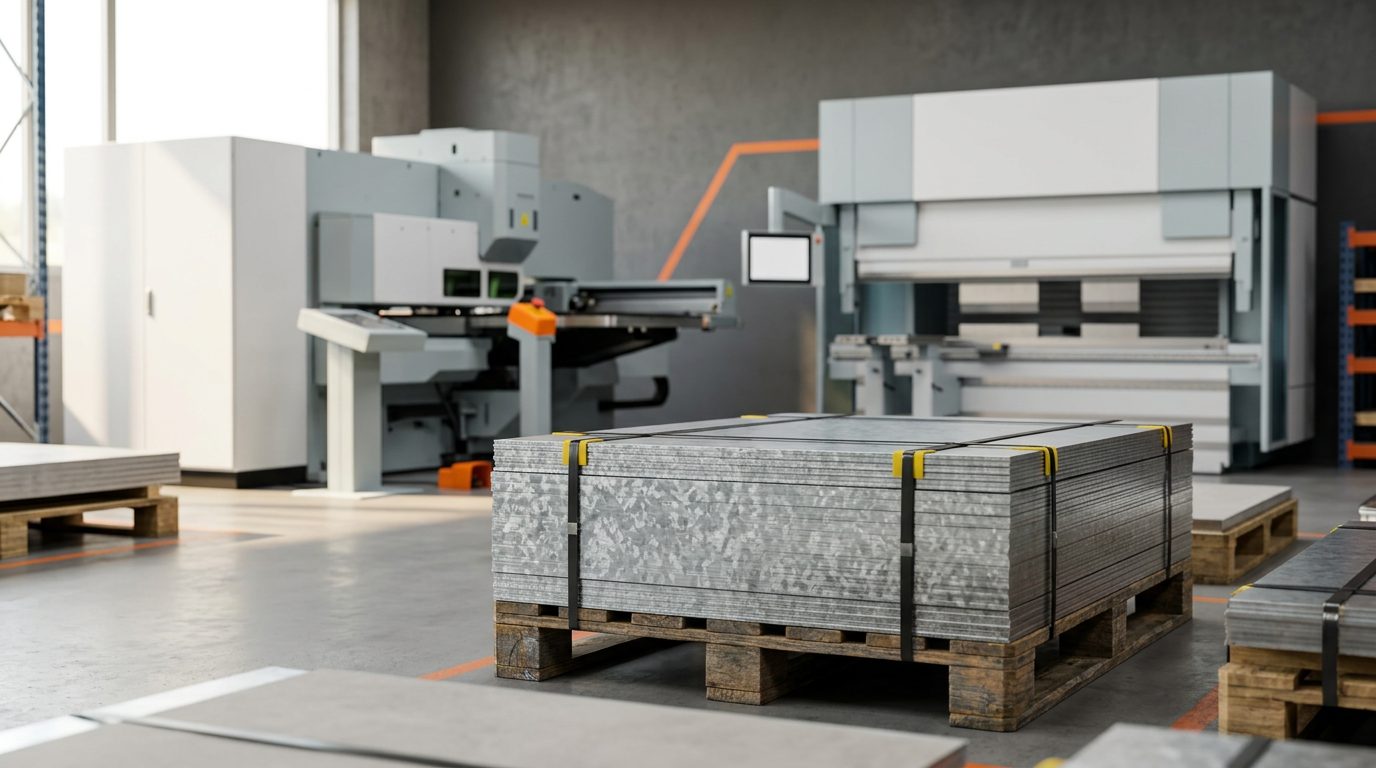
Galvanised steel sheet is steel sheet protected by a layer of zinc that prevents corrosion. It is the cheapest way to get a steel part into a humid or outdoor environment without painting. It is used for ventilation ducting, flashing, brackets, electrical enclosures and agricultural machinery. Here we sum up how it differs from ordinary steel and stainless, and when to choose it for a custom part.
How galvanised sheet protects steel
The zinc on the surface works in two ways: it forms a physical barrier and at the same time acts cathodically — even if the coating is locally scratched, the surrounding zinc protects the exposed steel by corroding preferentially in its place. That is why galvanised sheet survives minor damage that would mean a rust spot on painted steel. The most common process is continuous hot-dip galvanising (the strip is drawn through a bath of molten zinc during production), designated under the standard as DX51D+Z.
What Z275 means
The number after the Z gives the amount of zinc in grams per square metre on both sides combined. Z275 therefore means 275 g/m², i.e. roughly 20 µm of zinc on each side — the common standard for outdoor and humid environments. A heavier coating extends service life; a lighter one is used where the part will be painted later. Our stock is DX51D+Z275 — we keep the range narrow on purpose, because it comfortably covers ordinary engineering needs. We buy it in larger volumes, so for custom parts it is cheaper and available sooner than galvanised sheet ordered in specially. We stock it in 1 and 2 mm in a 1000 × 2000 mm sheet size, and in 2 and 3 mm in a 1250 × 2500 mm sheet size.
Galvanised or stainless?
Both resist corrosion, but in different ways and at a different price:
| Criterion | Galvanised sheet | Stainless steel |
|---|---|---|
| Price | low | considerably higher |
| Corrosion | normal outdoor / humid | also chemically aggressive, coastal |
| Appearance | technical, matt | decorative, can be polished |
| Cut edge | no zinc, may corrode | protected through the whole section |
For technical parts that are not on show and are fine in a normal environment, galvanised steel is cheaper and more practical. Where the part is visible or in an aggressive environment, go for stainless steel.
What to consider when designing a galvanised part
Two things cause the most trouble with galvanised steel:
- Cut and drilled edges. There is no zinc at a cut or a hole — on thin sheet the cathodic protection copes, but on thicker gauges or in very aggressive environments expect slight corrosion at the edge.
- Welding. The zinc burns off around the weld, producing fumes that are harmful to health. A welded joint therefore has to be treated with zinc spray, otherwise the protection disappears at the weld. Where possible, we prefer joints without welding (bends, rivets, screws).
The cheapest and fastest part is one designed for a stock thickness and sheet size. If you stay within what we hold in stock, there is no material to order and the part goes straight into production — laser cutting and subsequent bending on the press brake work on galvanised steel much as on ordinary steel.
We therefore recommend developing concepts, samples, prototypes and tests on stock galvanised sheet — it is cheaper and the material is available immediately. Only once the product is settled and production requires special technical properties (a different zinc coating weight or a different material) do we buy those for series production. We process sheet up to 6 mm in sheet sizes up to 1250 × 2500 mm — all stock thicknesses and sizes fit comfortably within that.
Frequently asked questions
Can galvanised sheet be painted?
Yes, but zinc is smooth and needs preparing (degreasing, a primer for galvanised surfaces or light abrading), otherwise the paint adheres poorly. If you plan to paint, consider whether painting ordinary steel would be cheaper.
What is the difference between hot-dip and electro-galvanised zinc?
Continuous hot-dip zinc (DX51D+Z) is applied when the coil is produced and is the standard for stock sheet. Batch hot-dip galvanising after the part is made gives a thicker coating for heavy structures; electro-galvanised zinc is thinner, more for small parts and interiors.
Does galvanised sheet corrode at the cut edge?
On thin sheet the surrounding zinc protects the edge cathodically, so it stays rust-free. On thicker gauges or in an aggressive environment, it is advisable to treat the edge with zinc spray.
Will you make a custom galvanised part as a one-off?
Yes, with no minimum quantity. If the part fits a stock thickness and sheet size, it is also cheaper and faster.
Need a part in galvanised sheet? Upload the file, choose the thickness and see the price and lead time instantly.