Materials · stainless steel
Stainless steel sheet: grades, thicknesses and how to choose
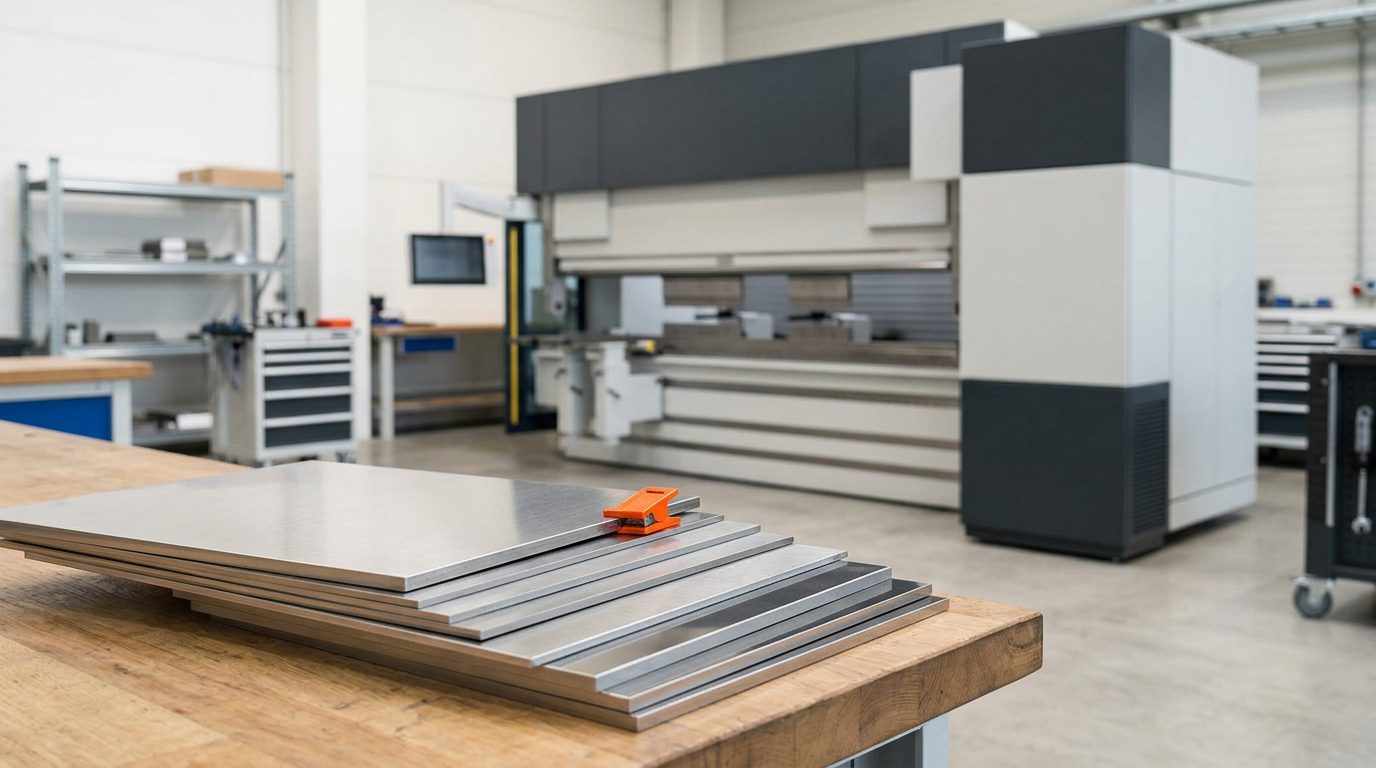
Stainless steel sheet is corrosion-resistant steel containing chromium, which forms a thin passive layer on the surface that prevents rust. It resists corrosion, cleans easily and looks good, but it is more expensive and harder to work than ordinary steel. Choosing the right grade, thickness and finish therefore decides both the price and whether the part will hold up. Here is an overview to help you choose.
The stainless steel grades you need to know
For the vast majority of parts, the austenitic 304 and 316 families are all you need:
- 1.4301 (AISI 304) — the most widely used stainless steel. Good corrosion resistance in normal and humid environments, easy to form and weld.
- 1.4307 (AISI 304L) — the low-carbon version of 304. The lower carbon content reduces the risk of intergranular corrosion after welding; otherwise it behaves like 1.4301. It is the all-round choice for welded parts.
- 1.4404 (AISI 316L) — with molybdenum, for significantly higher resistance to chlorides and acids. For food processing, chemicals, pharmaceuticals and coastal environments.
A simplified rule: in dry and normal environments 304/304L is enough; where salts, acids or constant moisture are a risk, choose 316L. Molybdenum makes 316L a more expensive material, so use it only where the chemistry of the environment really requires it.
Which grade we stock, and why
We stock a single stainless grade — 1.4307 (304L) with a 2B finish, in 1 / 2 / 3 / 4 mm and a 1000 × 2000 mm sheet size. We do this deliberately: a narrow range comfortably covers ordinary engineering needs, and we buy it in larger volumes, so this grade is cheaper and available straight away. For general use 304L is ideal — good corrosion resistance, good weldability thanks to the low carbon, and a favourable price. If the part has no specific chemical requirement, 304L is the right choice.
We order 1.4404 (316L) per job — it is more expensive and comes with a longer lead time, so we choose it only where the environment requires it (chlorides, acids, coastal sites). So if your design has no particular chemical reason to go for the molybdenum grade, stock 304L works out cheaper and the part goes into production sooner.
The recommended approach: develop concepts, samples, prototypes and tests on stock 304L — it is cheaper and the material is available immediately. For stainless trials and samples it is simply the right choice. Only once the product concept is settled and series production requires special technical properties do we buy 1.4404 (316L) or another grade for it — that is when a special material really pays off.
Common thicknesses and finishes
The most commonly processed stainless thicknesses are 1 / 2 / 3 / 4 mm — exactly what we have in stock. We process stainless up to 6 mm in sheet sizes up to 1250 × 2500 mm; our equipment deliberately covers the thin and medium-gauge segment — we do not make parts from thicker stainless plate. Choose the finish by how visible the part is:
| Finish | Appearance | Typical use |
|---|---|---|
| 2B | matt, smooth | technical and non-visible parts |
| brushed (e.g. K240) | finely ground | visible covers, catering |
| BA | bright, mirror-like | design and showcase parts |
On visible brushed parts, watch the grain direction — on adjoining faces and across bends it should run the same way, otherwise the transition shows.
How to choose the right stainless steel
Work from the environment and function towards the material, not the other way round:
- Environment — normal/humid → 304/304L; chlorides and acids → 316L.
- Visibility — not visible → 2B; visible → brushed or BA (more expensive, more careful handling).
- Thickness — the smallest that meets the stiffness requirement; stainless is dense and its price per kilogram high, so every tenth of a millimetre shows in the weight and the price.
- Availability — a stock grade and thickness is cheaper and faster.
If you need a specific custom part, this overview continues in the article stainless steel sheet cut to size, with the ordering process and how the price is built up.
Frequently asked questions
What is the difference between 304 and 304L?
304L (1.4307) has a lower carbon content, which reduces the risk of intergranular corrosion after welding. It is therefore the safer choice for welded parts, and otherwise behaves practically the same as 304.
When do I really need 316L instead of 304L?
When the part is exposed to chlorides (coastal sites, swimming pools, road salt) or acids. The molybdenum in 316L increases resistance to pitting corrosion. In dry, normal environments 316L is needlessly expensive. It pays to make samples and prototypes from stock 304L and bring in 316L only for series production.
How thick a stainless sheet can you process?
Up to 6 mm, in sheet sizes up to 1250 × 2500 mm. We stock 304L in 1 / 2 / 3 / 4 mm. We do not do thicker plate.
What does a 2B finish mean?
The standard cold-rolled finish — matt and smooth, with no further grinding. It is the most common and cheapest finish for technical parts.
Why is stainless sheet more expensive than galvanised or mild steel?
Because of the expensive alloying elements — chromium and nickel (plus molybdenum in 316L). Processing differs too. Where the corrosion resistance of stainless is not needed, galvanised steel sheet is often the cheaper choice.
Know which grade and thickness you need? Upload the model, choose the material and see the price of your stainless part instantly.