Perforated sheet
Perforated sheet metal: hole patterns, materials and uses
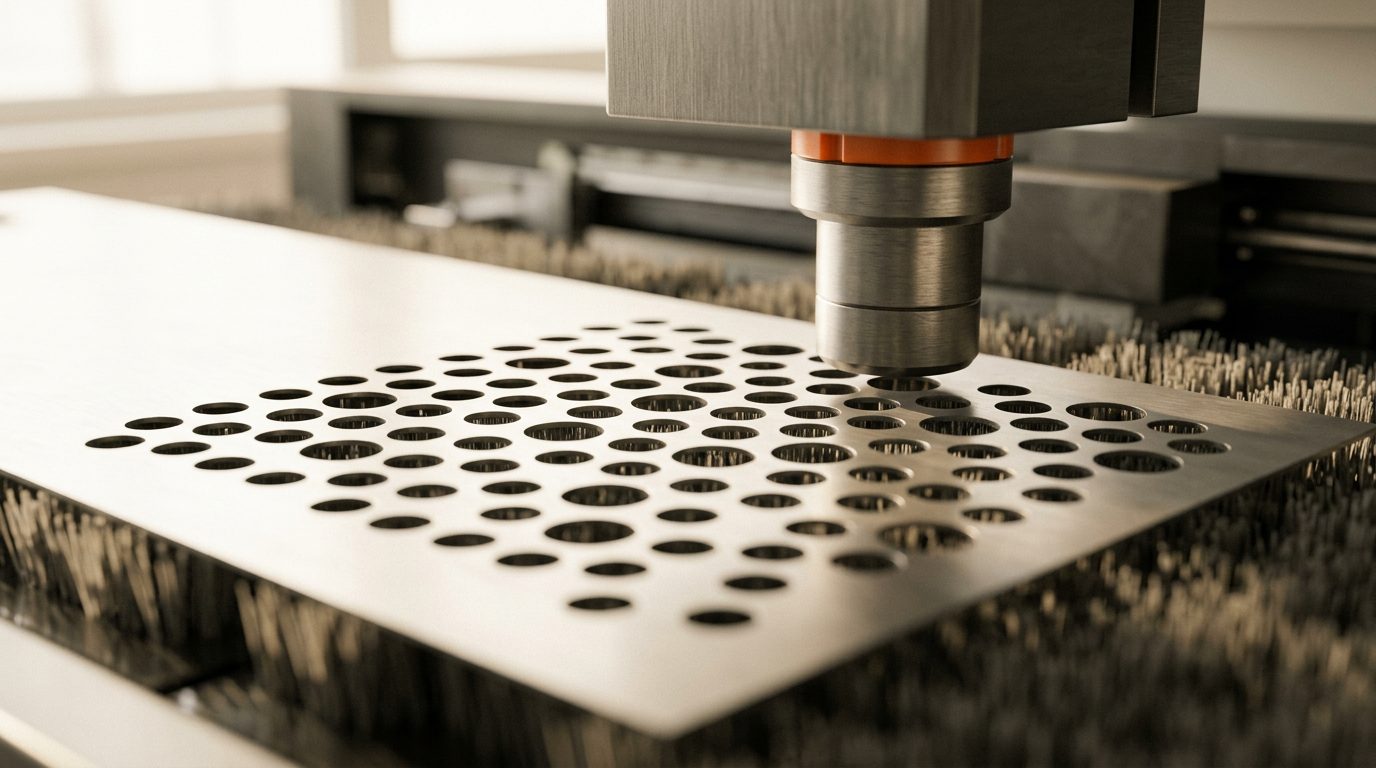
Perforated sheet metal is sheet with a regular pattern of holes that lets air, light or liquid through while keeping stiffness and low weight. It is used for covers, grilles, screens, façade panels and acoustic cladding. This overview will help you choose the hole pattern and material, and decide when a standard sheet is enough and when it pays to cut the perforation to size.
Types of perforation
Perforations differ in the shape of the hole and in how the holes are arranged on the sheet. These are the variants you will come across most often:
- Round holes (Rv). The most common. A 60° staggered pitch ("triangular" pattern) gives the highest open area and an even appearance. A designation such as Rv5-8 means a 5 mm hole on an 8 mm pitch.
- Square holes (Qg). A technical, clean-lined look and a larger open area at the same pitch. Suitable for screens and filter surfaces.
- Slotted (oblong) holes (Lv, Ls). Good flow while keeping strength in one direction; common on ventilation and acoustic panels.
- Decorative and custom patterns. Any motif, logo or gradient of hole density — that is the domain of cutting to size, not of stock sheet.
Open area and margins
The key parameter is the open area — the proportion of holes in the total area, usually 20–60 %. A higher open area means better flow and less material, but lower stiffness. On visible and installed parts, allow for an unperforated margin (border) for fixing and bending — perforation too close to a bend or an edge distorts and is hard to drill or weld. So leave a solid strip around the perimeter of the part at least one to two pitches wide.
Perforated sheet materials
Practically any engineering sheet can be perforated — it depends on the environment and appearance:
- Mild steel — the cheapest, for covers and interiors, usually with a subsequent finish (paint, powder coating).
- Galvanised steel — outdoor and humid environments without further painting; more in the article on galvanised steel sheet.
- Stainless steel — food processing, catering, visible and outdoor parts; easy to clean and does not corrode.
- Aluminium — low weight, common on façades and in ventilation.
Standard sheet or custom perforation?
If you need a common pattern over a large area, a ready-made perforated sheet from a mill supplier is usually the cheapest. But as soon as you need a specific size, part shape, bends, a custom pattern or just a small batch, it pays to laser cut the perforation from solid sheet. A laser handles any hole layout and the part outline in one file, and the edge stays clean — as described in the article on sheet metal cutting. The result is a part made to size, with no need to trim and edge a ready-made sheet.
We punch or cut perforation on a combined TRUMPF TruMatic machine, from sheet up to 6 mm in sheet sizes up to 1250 × 2500 mm. We do not do larger perforated areas or thicker plate — there, a ready-made sheet from a mill supplier is the right route. We recommend making samples and prototypes from stock materials (stainless 1.4307, mild steel DC01, galvanised DX51D+Z275), which are cheaper and available straight away.
Custom perforation follows a simple pricing rule: the price rises with the number of holes, because every hole is a separate cut. A dense, fine perforation over a large area is therefore much more expensive than a sparse pattern — allow for this at the design stage.
Frequently asked questions
What is the smallest hole that can be cut in sheet metal?
With a laser, a hole diameter roughly equal to the sheet thickness is taken as a sensible minimum. Smaller holes are possible, but the cut is slower and the edge less clean. For very fine, dense perforation, a ready-made sheet is the better option.
Can perforated sheet be bent?
Yes, but the bend must run through an unperforated strip or along a row of holes so that the perforation does not distort at the bend. Plan the bending margin at the design stage — see sheet metal bending.
How is a perforation type designated?
By a combination of shape, hole size and pitch, for example Rv5-8 (5 mm round holes on an 8 mm pitch) or Qg10-15 (10 mm square holes on a 15 mm pitch). For a custom part, simply send a drawing with the hole layout or a DXF.
Will you make a single perforated part?
Yes. We punch and laser cut perforation without special tooling or a minimum quantity, so we will quote and make even a single part or a small batch — from sheet up to 6 mm and in sizes up to 1250 × 2500 mm.
Have the size, material and perforation pattern in mind? Upload the file and see the price and lead time instantly — no waiting for a quote.