Bending · cost
Sheet metal bending cost: how it is priced by bends and length
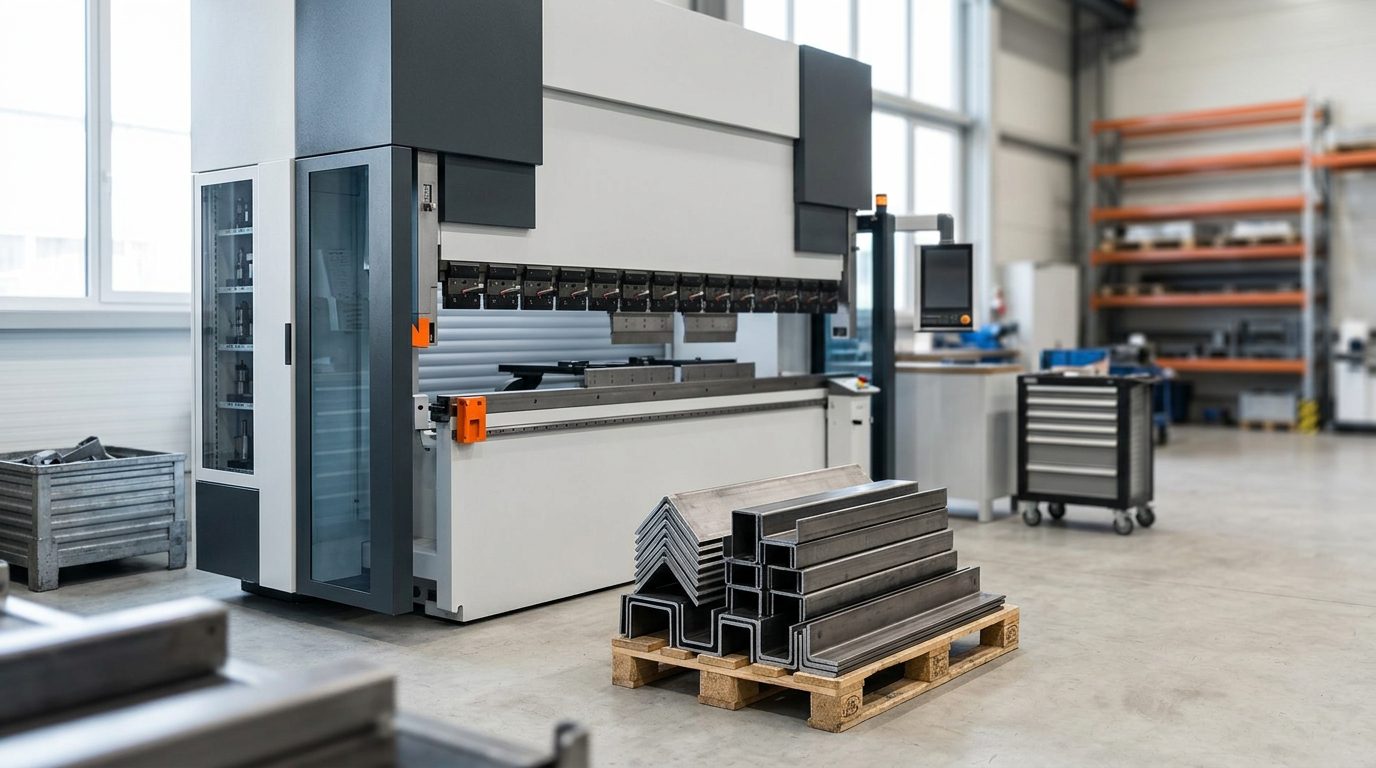
The cost of sheet metal bending is not one fixed figure per part — it is made up of several components that differ from part to part. Once you know what makes up the price, you can tell why one part is cheaper than another and, above all, design your part so it bends quickly and without complications. Below we look at how the price of bending is calculated and what affects it most.
What makes up the cost of sheet metal bending
Bending itself (press braking) is a machine operation on a press brake, and its price usually depends on these factors:
- Number of bends. Every bend means loading the part once, positioning it against the back gauge and one stroke of the press. More bends = more machine time per part.
- Bend length. A long bend across the whole sheet needs a longer tool and more force than a short flange; this shows in both time and the choice of tooling.
- Thickness and material. Thicker and harder sheet needs more forming force and different tooling. Stainless resists more and springs back more than mild steel.
- Set-up and preparation. Fitting the right tooling and program is a one-off time that shows more on a single part than on a batch.
- Quantity. On a larger batch the set-up time is spread over many parts, so the price per part falls.
The bending price almost always has to include the previous step too — the sheet first has to be cut into an accurate blank. That is why we assess the cost of sheet metal cutting and bending together as one production chain. In our shop TRUMPF machines cover all of it: a combined machine with a fibre laser and a punching head, and a TruBend press brake. We process sheet up to 6 mm thick in sheet sizes up to 1250 × 2500 mm — deliberately the thin and medium-gauge segment that our group of companies needs. We do not do thicker plate.
Why good part design matters
What drives the bending price up unnecessarily are details that are easy to deal with at the design stage. An inside radius that is too small, holes placed right next to the bend or an unrealistic bend sequence mean either more scrap or manual adjustment — and that shows in the price. If, on the other hand, the recommended radii and distances are respected, the part bends right first time. The specific limits and a table of minimum values are in the article on sheet metal bending.
Material as part of the price
Because the part is cut from a sheet before it is bent, the price of the sheet itself is also reflected in the final price. Choosing a commonly stocked grade and thickness helps a great deal here. We deliberately keep a narrow stock, because it covers ordinary engineering needs with room to spare: mild steel DC01 (1.5, 2 and 3 mm, 1000 × 2000 mm sheet size), galvanised sheet DX51D+Z275 (1 and 2 mm in 1000 × 2000 mm, 2 and 3 mm in 1250 × 2500 mm) and stainless steel 1.4307 (304L, 2B finish) in 1, 2, 3 and 4 mm. We buy stock material in larger quantities, so it is cheaper and available straight away.
We therefore recommend making concepts, samples, prototypes and test bends from exactly these stock materials — for stainless samples and tests, stock 304L is the right choice. We buy special grades, for example stainless 1.4404 (316L), only for series production, once the product concept is settled and production genuinely needs their technical properties.
How to get an exact bending price
Because the price is made up of the number of bends, length, thickness, material and quantity, a manual estimate tends to be inaccurate. In our instant quote calculator, the flat length, number of bends and price are calculated automatically from the uploaded 3D model (STEP/STP) — you see the result within seconds, lead time included.
Frequently asked questions
Is the price per bend or for the whole part?
The price is based on the whole part, but the number of bends is one of the main inputs. More bends mean more machine time, so the price per part goes up.
Why does bending stainless cost more than steel?
Stainless resists more, springs back more and the material itself tends to be more expensive. All of this is reflected in the forming force, the tooling and the price of the input sheet.
Is it worth ordering more parts at once?
Yes. The set-up and programming time for bending is a one-off, so on a larger batch the price per part falls. But we will quote and make a single part too.
Up to what thickness do you bend sheet?
Up to 6 mm, on a TRUMPF TruBend press brake. We do not bend thicker plate — our equipment is deliberately built for thin and medium-gauge sheet.
Do I need a drawing, or is a 3D model enough?
A 3D model (STEP/STP) is ideal for bending — we derive the bend sequence and flat length from it. A dimensioned drawing with angles and radii is a welcome addition. Only have a drawing, DXF or photo? Send it via the enquiry form and we will quote the part manually.
Have a part to be bent? Upload a 3D model (STEP/STP) and get the price and lead time instantly — no waiting for a sales quote.