Materials · stainless steel
Stainless steel sheet cut to size: stock grade, thicknesses and price
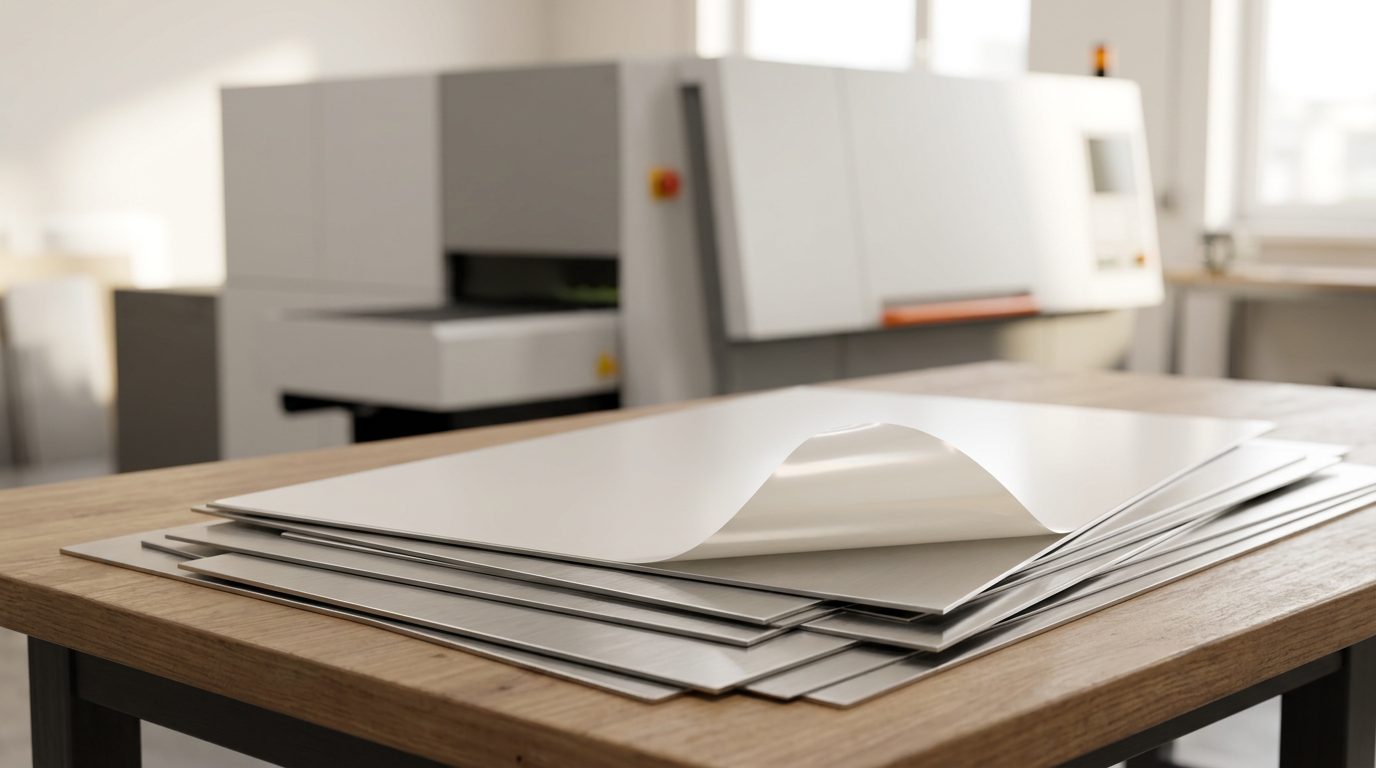
Do you need stainless steel sheet cut to size — a cover, frame, bracket or a part for a food or chemical plant? Stainless steel resists corrosion, cleans easily and looks good, but it is more expensive and harder to work than ordinary steel. You therefore save the most by choosing a grade and thickness the manufacturer holds in stock. Here is a practical overview of what affects a custom stainless part the most.
Stock grade 1.4307 (304L) as the default choice
We stock a single stainless grade — 1.4307 (AISI 304L) with a 2B finish, in 1 / 2 / 3 / 4 mm and a 1000 × 2000 mm sheet size. That is deliberate: a narrow range comfortably covers ordinary engineering needs, we buy it in larger volumes, and so this grade is cheaper and available straight away — a part from stock goes into production without waiting for a material order. For general use, 304L is also an ideal choice:
- Good corrosion resistance in normal and humid environments.
- Good weldability — the low carbon content (the "L") reduces the risk of intergranular corrosion after welding.
- Easy forming on the press brake and easy laser cutting.
- A favourable price compared with more highly alloyed grades.
If the part has no special chemical requirements, 304L is the right and cheapest choice for covers, frames, brackets and interior and architectural parts.
We therefore recommend developing concepts, samples, prototypes and tests on stock 304L — it is cheaper and the material is available immediately. For stainless trials and samples it is simply the right choice.
When to go for 1.4404 (316L)
1.4404 (AISI 316L) also contains molybdenum, which significantly increases its resistance to chlorides and acids. It is suited to environments that really require it: food processing with aggressive cleaning, chemicals, pharmaceuticals, and coastal or chlorinated (swimming pool) environments. We order this grade to order — it is more expensive and comes with a longer lead time. So choose it deliberately for the chemistry of the environment, not "just to be safe": without a specific reason, stock 304L works out cheaper and the part is ready sooner.
A proven approach: refine the concept and prototypes on 304L, and only once the product is settled and series production genuinely requires special technical properties do we buy 316L or another grade for it. That is when a special material really pays off.
Not sure? Tell us the environment and the function of the part, and we will recommend a grade. A broader comparison of grades is in our article on stainless steel grades.
Thicknesses and finishes
The stock thicknesses of 1 / 2 / 3 / 4 mm cover most custom parts. We process stainless steel up to 6 mm thick in sheet sizes up to 1250 × 2500 mm — our equipment deliberately covers the thin and medium-gauge segment; we do not make parts from thicker stainless plate. Choose the finish by how visible the part is:
| Finish | Appearance | Typical use |
|---|---|---|
| 2B | matt, smooth (in stock) | technical and non-visible parts |
| brushed (e.g. K240) | finely ground | visible covers, catering |
| BA | bright, mirror-like | design and showcase parts |
On visible brushed parts, watch the grain direction — on adjoining faces and across bends it should run the same way, otherwise the transition shows.
Cutting, bending and welding stainless steel
Stainless steel laser cuts well with a clean edge (see sheet metal cutting) and bends on a press brake much like steel, only with more springback and a slightly larger radius. When welding stainless, the key is to limit the heat input and then passivate the surface (by pickling or electrolytically) so that the passive layer is restored and the part does not lose its corrosion resistance around the weld. For clean, low-distortion welds we use laser welding.
What affects the price of a stainless part
The price of a custom stainless part is driven most by:
- Grade and availability — stock 304L is cheaper and faster than 316L ordered in specially.
- Thickness and weight — stainless is dense and its price per kilogram high, so the material is a large share of the price.
- Finish — brushed and especially BA sheet costs more than 2B and needs more careful handling (protective film against scratches).
- Complexity — cut length, number of bends, and the extent of welding and passivation.
- Quantity — on a batch the price per part falls.
A tip for saving money: if the part is not visible, stay with stock grade 1.4307 with a 2B finish and choose the smallest thickness that still meets the stiffness and function requirements — with dense stainless, every tenth of a millimetre shows in the weight and therefore in the price. For visible parts, on the other hand, allow for protective film and more careful handling, because scratches and fingerprints are easy to see on bright stainless.
The fastest way to find the price of a specific part is to upload the model to our instant quote calculator, choose the grade and thickness, and see the price and lead time straight away.
Frequently asked questions
Which stainless steel grade should I choose for general use?
Stock 1.4307 (304L). It has good corrosion resistance and weldability, is cheaper and available straight away — ideal for samples, prototypes and tests too. Go for 1.4404 (316L) only for series production in coastal, chlorinated or chemically aggressive environments.
How thick a stainless sheet can you process?
Up to 6 mm, in sheet sizes up to 1250 × 2500 mm. We stock 304L in 1 / 2 / 3 / 4 mm. We do not do thicker plate.
Can you also polish or grind stainless to a visible-quality finish?
Yes, we work with brushed and bright (BA) sheet and keep the grain direction consistent across adjoining faces. Tell us how the part should look.
Is passivation necessary after welding stainless steel?
For parts where corrosion resistance matters, yes — the area around the weld is the most sensitive spot, and passivation restores the protective layer. For purely technical parts with no corrosion requirements it can be omitted.
Will you make just one stainless part?
Yes, with no minimum quantity. We quote and make one-offs and prototypes in stainless just as we do batches.
Have the grade and shape in mind? Upload the model and get your stainless part quoted within seconds.