Laser-cut parts
Laser-cut parts from sheet metal: what they are, materials and ordering
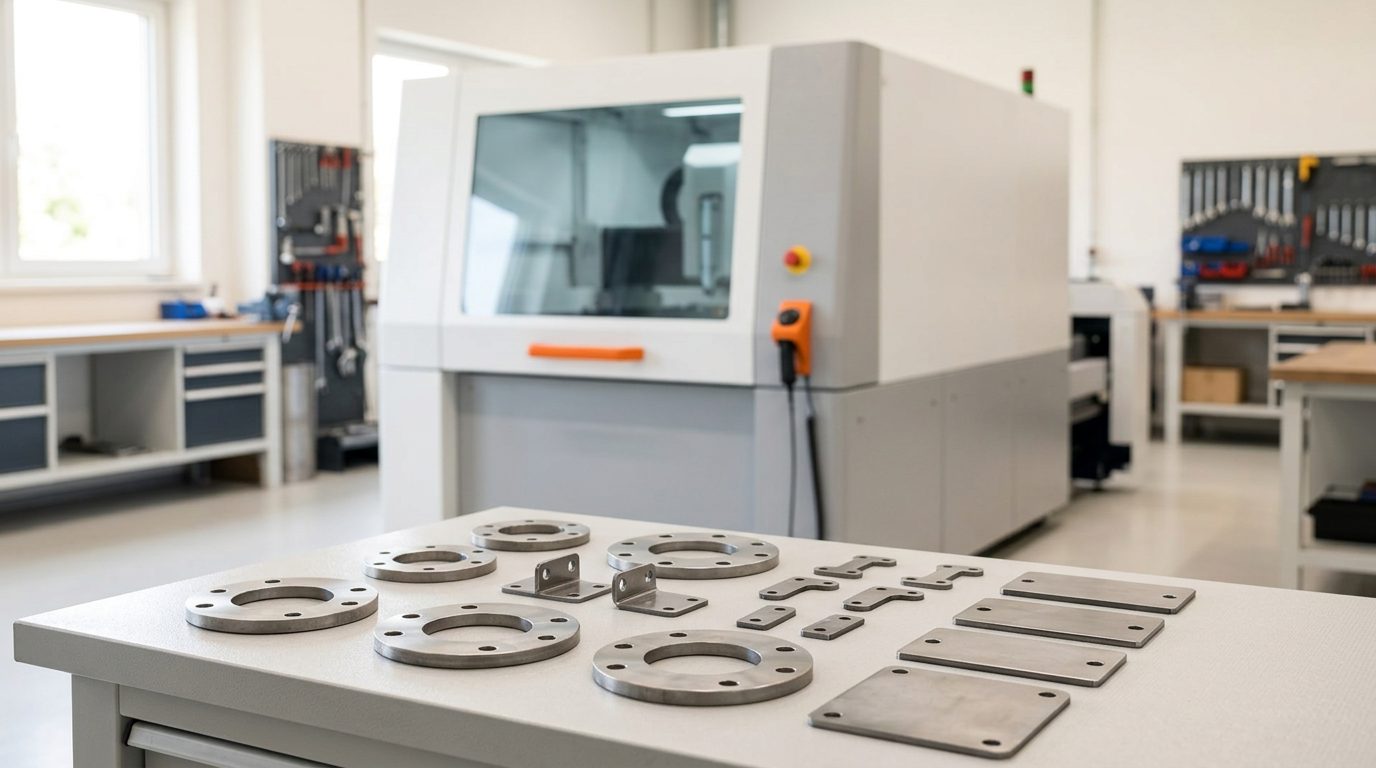
Laser-cut parts (also called cut blanks or profiles) are flat parts cut out of sheet to a given shape — outline, holes and cut-outs in one go. They are the basis of almost every sheet metal job: a laser-cut part is either a finished flat part or a semi-finished blank that is then bent, welded and machined. Here we explain what laser-cut parts are made of, what accuracy to expect and how to order them made to measure.
What a laser-cut part is and how it is made
The part is produced by thermal cutting — the material melts in the kerf and is blown away. Today, precision parts are most often cut with a fibre laser; plasma or oxy-fuel cutting are used elsewhere. In our shop, parts are made on a combined TRUMPF TruMatic machine (punching and fibre laser) from sheet up to 6 mm. A single file produces a finished blank with the outline, holes and cut-outs, ready for further processing straight away. One file (DXF or 3D model) defines the whole part.
Materials and thicknesses
Laser-cut parts are made from practically all common sheet materials. The choice of material determines the price and where the part will hold up:
- Cold-rolled mild steel sheet (DC01) — the cheapest, for covers, brackets and parts that are bent afterwards. We stock 1.5 / 2 / 3 mm.
- Galvanised sheet (DX51D+Z275) — corrosion resistance without painting; in stock in 1 and 2 mm (1000 × 2000 mm) and 2 and 3 mm (1250 × 2500 mm).
- Stainless steel (1.4307 / 304L) — food processing, visible and outdoor parts; in stock in 1 / 2 / 3 / 4 mm.
- Aluminium — low weight and natural corrosion resistance; we do not stock it, it is ordered per job.
The cheapest and fastest part is one designed for a thickness and grade that the manufacturer holds in stock and buys in larger volumes. An unusual material has to be ordered, which extends both lead time and price. So it pays to tune the design to the stock — in our case the thicknesses of DC01 steel, DX51D+Z275 galvanised and 1.4307 stainless listed above.
We keep a narrow stock on purpose: it comfortably covers ordinary engineering needs. We therefore recommend making concepts, samples, prototypes and tests from stock materials — it is cheaper and they are available immediately. We buy a special material (say stainless 1.4404 / 316L or another grade) only for series production, once the product is settled and genuinely needs its technical properties. All stock thicknesses are within our range of up to 6 mm.
Accuracy and edge quality
On laser-cut parts the edge is smooth, square and practically burr-free, so it needs no chamfering or grinding before further processing. The dimensional tolerance is in the tenths of a millimetre — accurate enough even for parts that are later welded or fitted. Plasma and oxy-fuel cutting usually have a wider kerf and an edge with a slight bevel — allow for this where precise fitting is needed. An accurate blank is also a precondition for an accurate bend: bending cannot fix an inaccurate edge.
How to order a custom laser-cut part
To quote a laser-cut part, the part geometry and material are all we need:
- Flat part — send a DXF of the outline including holes and cut-outs.
- A part that will be bent — send a 3D model (STEP/STP) instead; we derive the flat pattern from it with the correct flat length.
- Material and thickness — if you are not sure, we will advise based on the function and environment of the part.
The price of a laser-cut part is made up mainly of material (weight and price per kilogram of the grade), cut length (perimeter plus holes and cut-outs), number of features (every hole is a lead-in and a pierce) and quantity. Because there are several variables, a manual estimate tends to be inaccurate — in our instant quote calculator everything is calculated automatically from the uploaded file.
Frequently asked questions
What is the difference between a laser-cut blank and a finished part?
A blank is a flat piece cut out of sheet. If it is not bent or welded any further, it is a finished part in its own right; otherwise it serves as a semi-finished product for further operations.
Up to what thickness can you cut parts?
Up to 6 mm, in sheet sizes up to 1250 × 2500 mm. Our modern equipment deliberately covers the thin and medium-gauge segment that our group of companies needs. We do not cut parts from thicker plate and do not offer plasma cutting.
Do the edges need finishing after cutting?
With laser, usually not — the edge is clean and burr-free. We chamfer or deburr only where the function of the part or safety requires it.
Will you make just one laser-cut part?
Yes — with no tooling and no minimum quantity, we will quote and make even a single part. On a larger batch, the price per part then falls.
Have the shape of your part ready? Upload a 3D model (STEP/STP) and see the price and lead time of your laser-cut part instantly.