Bending · hand vs. machine
Hand bending vs. press brake bending — when to outsource the job
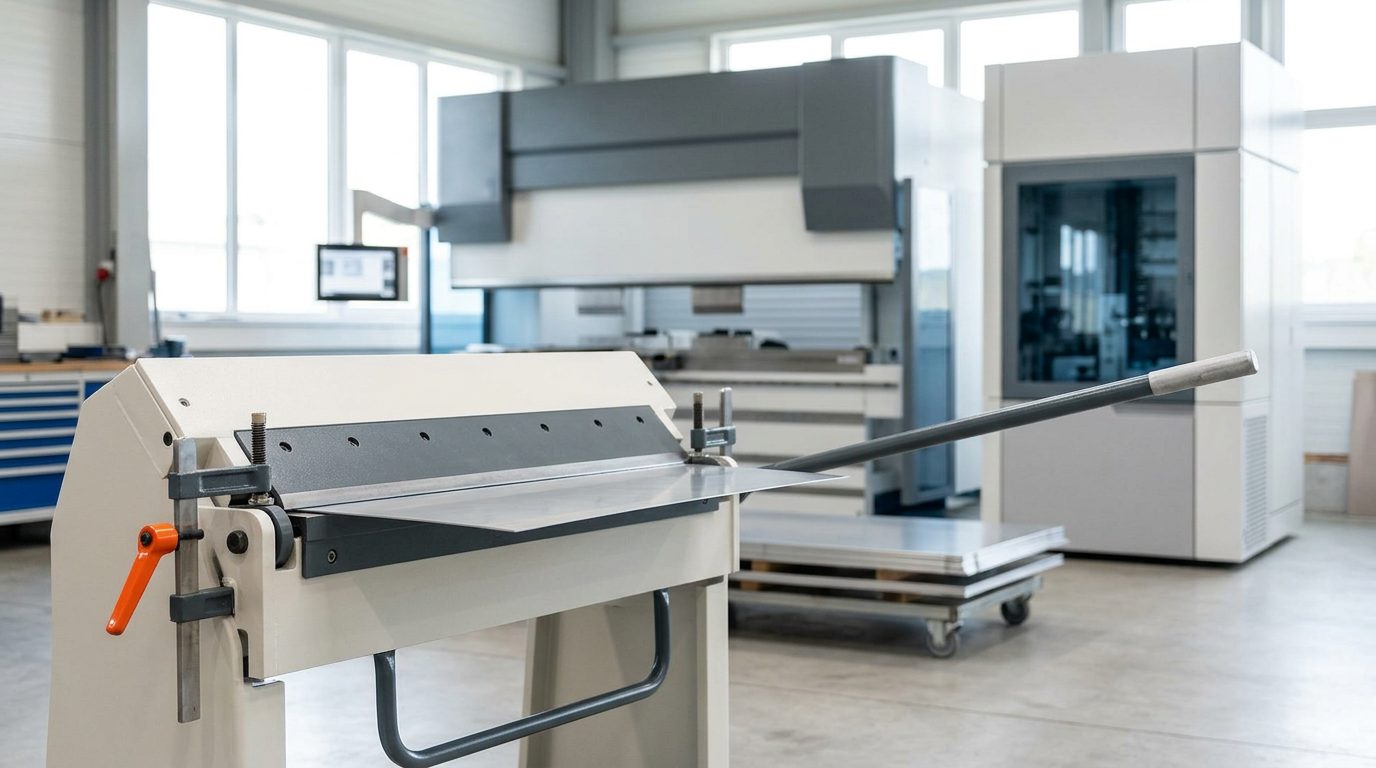
Hand bending sheet metal on a workshop folder is a quick, accessible solution for simple, thin parts. For more accurate, stiffer or repeated parts, however, it runs up against its limits, and CNC press brake bending pays off. In this article we go through the differences and help you see when the balance tips towards outsourcing the job.
How hand bending works
A manual (box and pan) folder clamps the sheet between a clamping beam and the bending edge, and the operator folds the protruding part up with a lever. The angle is set with a stop and checked by eye or with a protractor. It is cheap, needs no set-up and serves well for thin sheet, flashing, simple hems and one-off repairs. The drawbacks are the manual setting of the angle, limited stiffness on thicker sheet and dependence on the operator's skill — two identical parts will never be quite the same.
How press brake bending works
On a CNC press brake, the punch presses the sheet into a V-shaped die, and the depth of the stroke sets the angle. The CNC control holds the programmed angle and the back gauge positions the blank automatically, so the first and last parts of a batch come out the same. The result is high accuracy (angular tolerance typically around ±0.5°), repeatability across the whole batch and the ability to handle complex parts with many bends. Our pillar article on sheet metal bending describes this in detail.
We bend on a TRUMPF TruBend press brake — parts from sheet up to 6 mm thick, which we cut on our own combined TRUMPF machine (laser with a punching head). It is deliberately equipment for thin and medium-gauge sheet, which our group of companies needs. We do not do thick plate or heavy structures.
Comparison
| Criterion | Hand bending | Press brake bending |
|---|---|---|
| Angle accuracy | depends on the operator | measured, approx. ±0.5° |
| Repeatability | low | high (whole batch identical) |
| Sheet thickness | mainly thin sheet | in our shop: sheet up to 6 mm |
| Complex parts | difficult | many bends, controlled sequence |
| Set-up | none | minimal (automatic tool setting) |
| Suited to | one-offs, repairs, hems | precision parts, batches, covers, frames |
When it pays to outsource bending
Outsourced machine bending makes sense as soon as accuracy, repeatability or a stiffer material come into play. Typically when you need several identical parts, the part has many bends or has to fit with another component, or when a manual folder is not stiff enough for the thickness. Thanks to automatic tool setting, even a single part is economical on a CNC press brake — there is no expensive set-up as with press tools. For the part to fit after bending, the flat length of the blank must be right too; the article on bend allowance and flat length explains how it is calculated.
Frequently asked questions
Can a jobbing shop handle a single part?
Yes. Thanks to automatic tool setting, even a single part or a small batch is economical on a CNC press brake — no expensive set-up is needed.
Why doesn't my hand-bent part come out exactly to size?
Most often because of the manually set angle, springback of the material and an inaccurate flat length of the blank. Press brake bending controls the angle with a CNC program and derives the flat length from the model.
Up to what thickness does a manual folder make sense?
It depends on the machine, but manual folders are mainly at home with thin sheet. On thicker material they lack stiffness and clamping force, so the angle "drifts" and the part is harder to repeat.
Up to what thickness do you bend?
Sheet up to 6 mm on a TRUMPF TruBend press brake. We do not bend thicker material — our production is deliberately built for thin and medium-gauge sheet.
What should I send so the part can be bent on a machine?
Ideally a 3D model (STEP/STP) — the bend sequence and the flat length are derived from it. For a flat part a DXF of the flat pattern is enough; a dimensioned drawing with angles and radii is a welcome addition.
Need accurate, repeatable bends? Upload a 3D model (STEP/STP) and see the price and lead time instantly.