Custom metal fabrication
Custom metal fabrication: from laser-cut blank to finished weldment
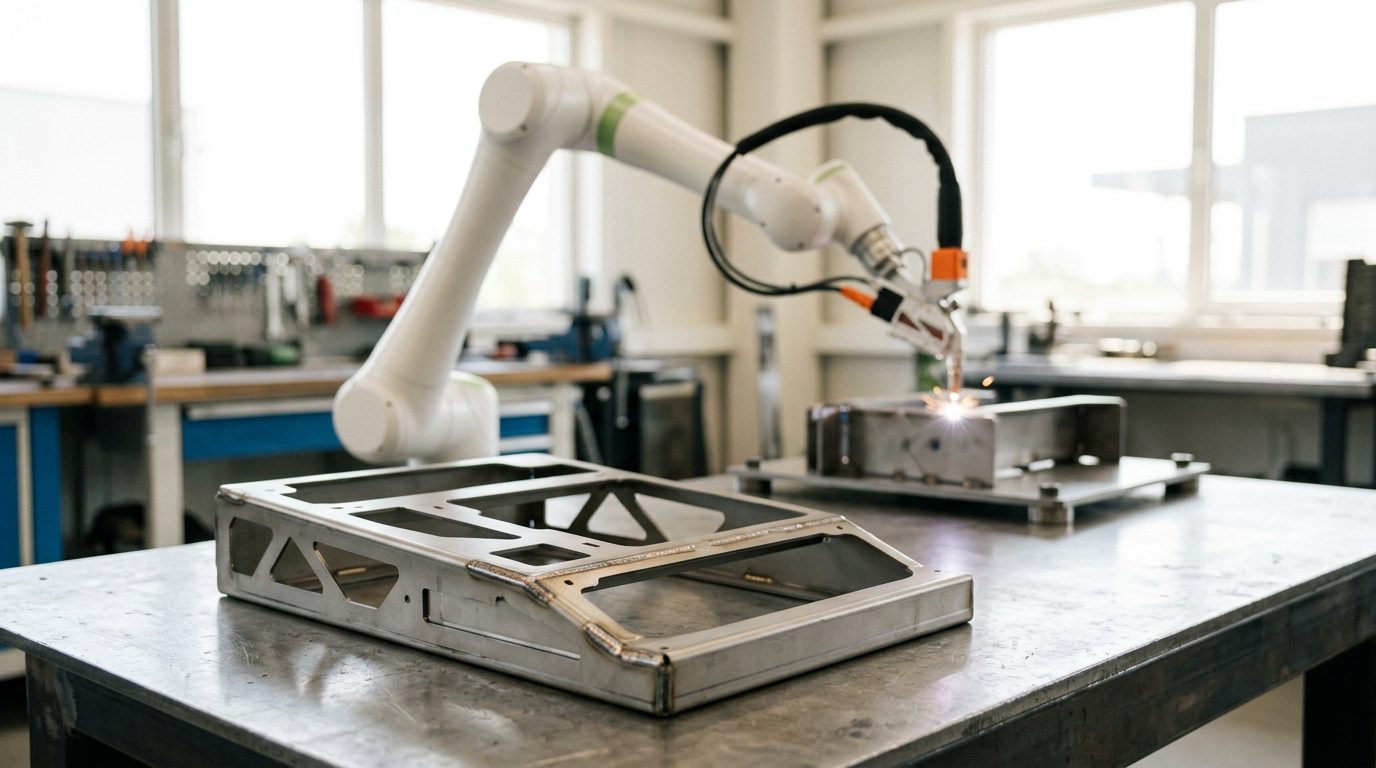
Custom metal fabrication means making metal parts to the customer's documentation — from a single part to a batch, without dedicated tools or moulds. It covers sheet metal cutting, bending, welding and finishing combined into one production chain. This overview walks you through the individual steps and shows where you can save the most on a custom part.
What custom metal fabrication involves
Most sheet metal parts go through the same sequence of operations. Not every part needs all of them:
- Cutting (the blank). A sheet becomes a flat blank with holes and cut-outs, usually by laser or punching. In our shop from sheet up to 6 mm in sheet sizes up to 1250 × 2500 mm. Details in the article on sheet metal cutting.
- Bending. The flat blank is bent into a three-dimensional shape on a press brake — see sheet metal bending.
- Joining. Welding, riveting, press-fit nuts and bolted joints. A weldment is an assembly of several parts joined by welding.
- Finishing. Wet paint, powder coating, passivation of stainless, or leaving galvanised steel untreated.
Choosing the material
The material is chosen by environment, visibility and price. In practice three groups cover most jobs:
- Structural steel (mild steel) — the cheapest, for load-bearing and concealed parts, usually painted.
- Galvanised sheet — outdoor and humid environments without painting (galvanised steel sheet).
- Stainless steel — food processing, chemicals, visible parts (stainless steel grades).
Whether the chosen material is in stock shows strongly in price and lead time. Common grades and thicknesses that a manufacturer buys in larger volumes tend to be cheaper and available straight away; an unusual material has to be ordered, which extends the lead time and raises the price. So it pays to tune the design to what is in stock. We keep a narrow stock on purpose, because it comfortably covers ordinary engineering needs: stainless 1.4307 (AISI 304L) with a 2B finish in 1 / 2 / 3 / 4 mm, cold-rolled mild steel DC01 in 1.5 / 2 / 3 mm, and galvanised DX51D+Z275 in 1 / 2 mm (1000 × 2000 mm) and 2 / 3 mm (1250 × 2500 mm).
We recommend developing concepts, samples, prototypes and tests on exactly these materials — it is cheaper and they are available immediately. Only once the product is settled and series production requires special technical properties do we buy a special material for it (for example stainless 1.4404 / 316L or another grade). That is when a special material really pays off.
What we make in-house — and what we don't
Our modern equipment deliberately covers the thin and medium-gauge segment up to 6 mm that our group of companies needs: the TRUMPF TruMatic combined punch-laser machine with a fibre laser, and the TRUMPF TruBend press brake. The working format is 1250 × 2500 mm; larger sheets have to be sheared to size first. We do not offer plasma cutting, waterjet or thick plate work — if your part needs these, we will tell you straight that we cannot make it.
How to design a part to cost less
Most savings are made in the drawing, not on the shop floor:
- Stick to a stock thickness and grade — there is no material to order and the price per kilogram is lower.
- Limit welding. A weld is an expensive manual operation followed by finishing. Where possible, replace it with a bend, a rivet or a press-fit nut.
- Standardise thicknesses and materials within an assembly — fewer machine changeovers.
- Allow for tolerances and assembly — an unnecessarily tight tolerance adds cost; design the parts to fit together even with normal production variation.
- Take advantage of batches — with more parts, the price per part falls thanks to better sheet utilisation and less set-up.
One-off or batch
The advantage of custom fabrication on a laser and a press brake is that it needs no expensive tooling. Even a prototype or a single part is therefore economical — it is quoted the same way as a batch, just without the volume savings. That is ideal for validating a design before you order a larger quantity.
Frequently asked questions
What information do you need for a quote?
Ideally a 3D model (STEP/STP) for bent parts and weldments, or a DXF for flat parts. A supporting dimensioned drawing with tolerances, material and finish is welcome.
Do you also handle finishing and welding?
Yes, we treat the job as a complete chain — from the laser-cut blank through bending and welding to finishing, so the part arrives finished.
Will you make just one part or a prototype?
Yes, with no minimum quantity. Thanks to toolless set-up, a single part or a small batch is economical.
How long does production take?
The lead time depends mainly on material availability and the scope of operations. A part in stock material goes into production straight away; you see the lead time and price in the calculator as soon as you upload the file.
Have a 3D model of the part (STEP/STP)? Upload it and see the price and lead time for custom fabrication immediately, with no waiting for a quote.